

To buy raw silk fabric online in the UK, compare its composition, weave, width, weight and finish, then decide whether a plain cloth or print suits your design. Printed silk puts pattern and colour first; plain silk lets texture, lustre and construction shape the effect.
Choosing silk online can feel uncertain when names and specifications vary. A fabric that looks beautiful on screen still needs to suit its intended use. Width affects pattern layout, weight influences feel and drape, and composition tells you what the fabric is made from.
This guide explains how to compare silk types, widths, weights, compositions and prints when buying by the metre in the UK. It also offers a practical way to weigh up plain and printed fabrics, helping you narrow your options and choose material suited to your project.
Key Takeaways
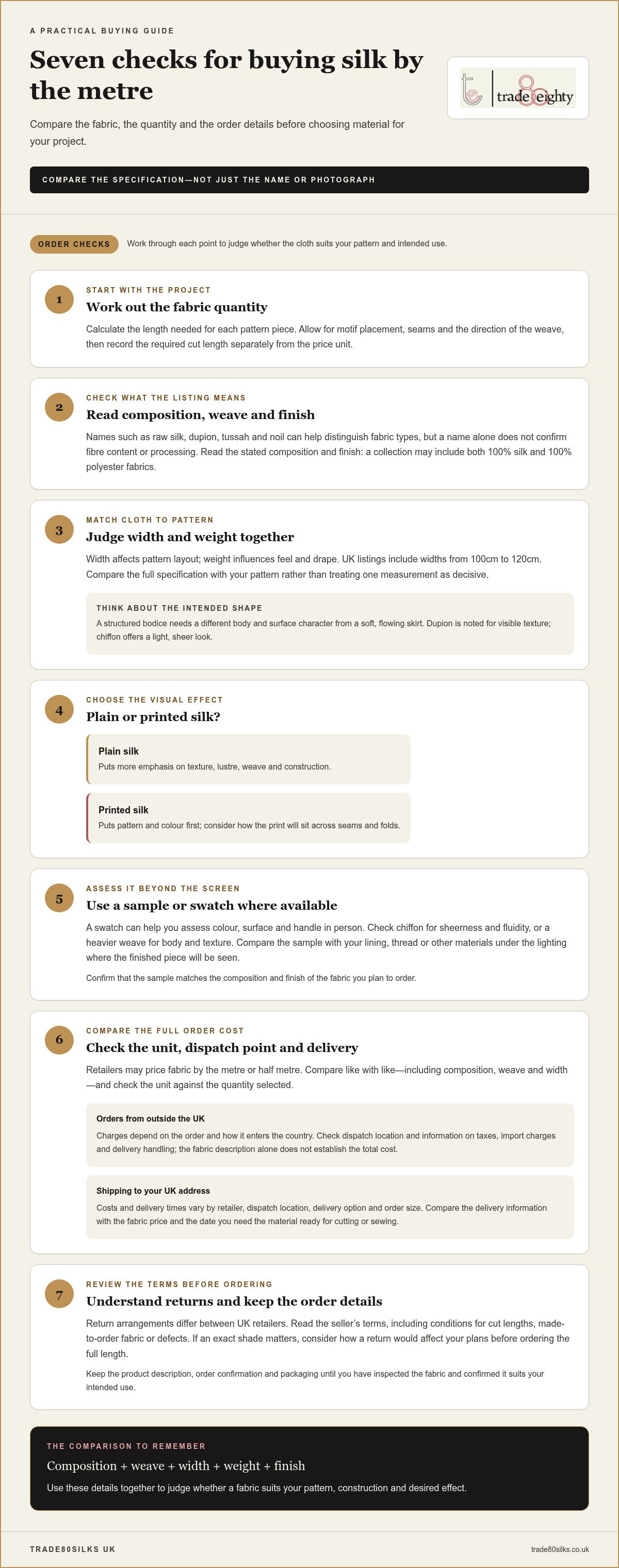
- Work out how much fabric your design needs, allowing for pattern placement, seams and the direction of the weave.
- Compare silk types by their weave and finish, as these shape the cloth’s surface, drape and overall character.
- Use fabric width, weight and composition together to judge whether a material suits your pattern and intended use.
- Choose plain silk to foreground texture and finish, or printed silk when colour and pattern are central to the design.
- Explore options such as Crinkle Silk Satin when a textured surface would serve your project better than a smooth finish.
Silk fabric by the metre
Buying by the metre lets you order a quantity that suits your pattern, rather than a finished garment. Before choosing, compare the price unit, fabric width and cut length.
Meterage and Half-Metre Pricing
Retailers may price silk by the metre or half metre, so check the unit shown against the quantity selected. Compare like with like, including composition, weave and width, rather than judging by price alone.
Before ordering, calculate the fabric needed for each pattern piece, allowing for motif placement and cutting direction. Chiffon is delicate and needs careful handling during construction. Smooth silk and textured cloth can also behave differently in the same design. Record the required length separately from the price unit.
Samples and Swatches
Some UK retailers offer samples or swatches, while others sell fabric by cut length only. A swatch helps you assess colour, surface and handle in person, details that a screen image cannot fully convey. With silk chiffon, check its sheerness and fluidity; with a heavier weave, assess its body and texture.
Compare a sample with your lining, thread or other materials under the lighting where the finished piece will be seen. Check that it matches the composition and finish of the fabric you plan to order. This is particularly useful when the design depends on a precise colour match.
Returns for Online Fabric Orders
There is no single return arrangement shared by every UK fabric retailer. The seller’s terms explain how returns work, including any conditions relating to cut lengths, made-to-order fabric or defects. Read those terms before placing an order, and keep the product description and order confirmation for reference.
If your project requires an exact shade, consider how a return would affect your plans before ordering the full length. Where available, a swatch lets you assess the material first. Keep the packaging and order details until you have inspected the fabric and confirmed it suits your intended use.
Import Duties and VAT on Orders from Outside the UK
Charges for raw silk ordered from outside the UK depend on the order and how it enters the country. The fabric description alone does not establish the total cost. Review information about taxes, import charges and delivery handling so you can separate the fabric price from additional charges.
Check where the order will be dispatched from, rather than relying only on the seller’s location or website language. Save the item description and checkout summary, which show the order details and any charges presented at purchase. This clarifies the total cost before you commit.
Shipping Costs and Delivery Times
Shipping costs and delivery times vary by retailer, dispatch location, delivery option and order size. Fabric length may affect packaging, while the destination and chosen service shape transit arrangements. Compare the delivery information for your UK address with the fabric price and the date you need it.
Plan around when the fabric must be ready for cutting or sewing, not when you hope to start browsing. If your project uses several fabrics, account for each parcel’s delivery arrangements. This is especially useful when coordinating delicate silk chiffon with lining or contrasting material.
Silk fabric types and product range
Silk’s character varies with its fibre, weave and finish, so a collection can include crisp, textured and fluid fabrics. Match these qualities to the garment’s structure and the effect you want.
UK listings may use names such as raw silk, dupion, tussah and noil. These labels help distinguish fabric types, but a name alone does not prove that a cloth is genuine silk or untreated.
To assess a claim, read the stated fibre composition and finish, then compare them with the product description. A photograph can show texture and colour, but it cannot establish fibre content or processing on its own.
Silk for Dressmaking
For dressmaking, start with the garment’s shape: a structured bodice needs a different body and surface character from a soft, flowing skirt. Dupion is worth considering for its visible texture, while chiffon offers a light, sheer look. Match the fabric’s handle and finish to the pattern’s intended silhouette.
Before choosing a textile, consider how its surface will look across seams and folds. A vibrant print can become the focal point, while a plain weave places greater emphasis on cut and construction.
Fabric Materials and Finishes
Read the composition separately from the fabric name. A retailer’s silk collection can include both 100% silk and 100% polyester variants, so the word “silk” in a range title doesn’t identify the fibre content of every listing.
Finishes also change a fabric’s look and feel. Compare smooth and textured surfaces, and check whether the description identifies a print or other treatment. For untreated fabric, look for clear information about the finish rather than assuming that “raw” means unprocessed.
Raw silk typically refers to silk fabric with a more natural, textured appearance. UK listings may also use names such as dupion, tussah and noil. Compare each listing’s fibre composition, weave and finish, because the name alone does not establish those details.
Price per metre reflects the fabric’s composition, construction, finish and the amount ordered; compare listings using the same unit. If one fabric is priced by the half metre and another by the metre, convert the quantity basis before weighing their value. Bespoke fabric commissions can suit projects requiring a considered textile direction beyond a standard selection; explore custom textile possibilities.
Fabric widths, weights and compositions
Width, weight and fibre content together shape how silk sits, cuts and performs. Compare all three with your pattern rather than treating any one specification as decisive.
Available Fabric Widths
UK silk listings include widths from 100cm to 120cm, and from 121cm to 150cm. A Silk Crepe de Chine listing, for example, gives a width of 135cm. That extra usable width can affect pattern layout, particularly for broad pattern pieces or designs requiring careful placement.
Check whether the stated measurement describes the full fabric width, then consider the selvedges when planning your cut. A Silk Panel measuring 141cm by 93cm is a fixed panel, not a continuous metreage width. Distinguishing a panel from fabric sold by length helps prevent errors when estimating how much material a pattern needs.
For a practical comparison, place the fabric width beside your pattern’s largest pieces. A 135cm-wide cloth may allow a different layout from one measuring 100cm, even when both are silk. The pattern’s grain direction and the fabric’s texture also influence placement. Organza, for instance, can make layout and seam allowances more visible.
Width alone does not establish value or suitability. A beautiful, wide cloth may need careful placement if its design has a clear direction or its surface catches light unevenly. Compare the listed width with your pattern layout, then check that the remaining cut length is enough for construction.
Fabric Composition
Read the composition field alongside the fabric name. Atelier - Safari Rust is listed as a silk-cotton blend, 140cm wide and weighing 38gsm. This example shows why a silk description doesn’t always mean a fabric consists solely of silk; fibre content can change the cloth’s hand and intended use.
If a listing names viscose or another fibre, treat that as a composition detail, not a finish. Compare the stated fibres before assessing texture, drape and durability, since blends can behave differently from pure silk. Keep the composition information with your pattern and care notes.
Weight is expressed using different units across silk listings. For example, Silk Crepe de Chine is described as 16 Momme, whilst Atelier - Safari Rust is stated as 38gsm. These figures use different measurement systems, so compare like with like rather than treating them as directly interchangeable.
A useful selection process is to match the stated weight to the garment’s structure, then assess width and composition. For a light, translucent effect, consider how silk organza’s texture will suit the design. For a more substantial result, compare measured weight and fibre content, not the fabric name alone.
Before ordering, record the exact fabric name, width, weight and composition. Comparing these details across listings helps distinguish similar-looking textiles and supports a deliberate choice for dressmaking or another project.
Choosing fabric by weight and construction
Weight is a useful starting point, but weave and finish also shape how silk moves. Compare the stated weight with the construction, then consider how both will behave in your design. A piece with intricate folds needs different movement from a garment built around clean, structured lines.
Consider the contrast between light crepe de chine and heavier satin. Crepe de chine’s woven surface gives it a softer, less reflective character, while satin construction creates a smoother, more lustrous face. Each fabric drapes differently, affecting where folds gather and how the finished silhouette catches light.
Product descriptions may use a weight notation such as 40MM, as in Heavy Double Silk Satin Natural White 40MM and Sandwashed Heavy Silk Satin Natural White 40MM. Treat that figure as a useful comparison within listings using the same notation. Don’t directly compare it with a weight stated in a different unit without accounting for the difference.
Construction matters beyond appearance. A tightly structured weave can hold a more defined shape, while supple cloth follows the body more closely. For designs with intricate seams or gathers, consider how the fabric’s body will support those details. Smooth satin can make folds prominent; a textured surface creates a different visual rhythm.
Composition also affects how weight feels in use. A fabric blended with cotton may handle differently from one made entirely of silk, even at a similar listed weight. Compare fibre details with construction, then consider the intended garment, its lining and the movement the pattern requires.
Use this practical comparison before choosing:
- For fluid shapes: look for a construction that drapes readily, such as crepe de chine.
- For a lustrous surface: compare satin weaves and their stated weight, including the 40MM examples.
- For structured details: assess whether the fabric’s body can support seams, folds and the pattern’s shape.
- For blended cloth: weigh the fibre composition alongside the finish, rather than relying on the word “silk”.
Finally, match the fabric to how it will be cut and assembled. A bias-cut panel, fitted bodice and gathered skirt make different demands on movement and body. Comparing weight, construction and composition together helps you choose a textile that supports the design rather than working against it.
Plain and printed silk fabrics
Plain and printed silk create different visual priorities: plain cloth foregrounds weave and finish, while a print puts pattern and colour in focus. Compare the design with the garment’s shape, especially if motifs need careful placement across seams.
For a plain option, silk satin offers a smooth surface with distinct lustre. Sand-washed silk has a more muted character, so its finish can shape the mood even without a print. Consider whether the cloth should reflect light or provide a quieter surface for the design.
Printed silk can weave a motif into the cloth or apply colour across its surface. For example, dark orange floral printed silk jacquard combines a floral pattern with woven texture. Red and white checkered silk shantung offers another clear direction, with a graphic repeat that can guide the garment’s style.
Plan printed fabric around the pattern pieces, not just the overall garment. Check the motif’s scale, direction and repeat, then consider where it will fall at the centre front, seams and hems. For bridal designs, a restrained print may complement a plain bodice; a more vibrant design can feature on sleeves or panels.
Lightweight printed silk organza adds colour while retaining a sheer appearance. Paired with plain fabric, it can create layered effects, though the underlayer will influence how the colours read. Compare the print over the intended lining or base cloth rather than judging it alone.
- Choose plain silk satin when a smooth, lustrous surface should lead the design.
- Consider sand-washed silk when a softer-looking finish better suits the overall mood.
- Look at printed jacquard when woven texture and pattern should work together.
- Use a check or floral print when motif placement can become part of the garment’s visual composition.
Colour also shifts with finish and surrounding fabric. A pale print layered over another cloth may look different from the same colours viewed alone. Before cutting, mark how the design should meet at seams, then place prominent motifs where they support the silhouette.
Washed finishes, printed surfaces and satin lustre each offer a distinct design language. Compare the fabric’s surface, print scale and intended placement before settling on a direction. Explore silk fabric finishes to consider how texture and pattern could shape your next design.
Trade80Silks UK: Crinkle Silk Satin ( #167 )
Trade80Silks UK offers Crinkle Silk Satin ( #167 ) for designs where a textured satin surface supports the intended look. It can be considered alongside Printed Silk Organza ( PS PEG 5 ), Printed Tulle ( PS PET 3x ) and Printed Silk Devore' ( PS CP8 ), depending on whether your project calls for texture, a printed surface or a sheer effect.
Compare each fabric’s character with your pattern, colour direction and construction before deciding which suits the design. If your project calls for a more individual textile direction, bespoke fabric commissions can develop a fabric around your creative brief.
Contact Trade80Silks UK to discuss which fabric direction suits your project.
Give your next silk project a considered beginning
Turn your fabric decision into a clear creative direction. Note the surface, colour mood and role the cloth should play, then consider how it will work alongside the other materials in your design. This helps you compare options against the finished effect you want, rather than choosing on appearance alone.
As you decide where to buy raw silk fabric online in the UK, Trade80Silks UK offers materials including Crinkle Silk Satin ( #167 ), Printed Silk Organza ( PS PEG 5 ) and Printed Tulle ( PS PET 3x ). Each brings a distinct surface or visual quality to a project, giving designers and makers considered options for developing their ideas.
Share your fabric requirements and creative direction with Trade80Silks UK about silk fabric. A thoughtful choice can give your design a confident starting point, and help its details come together with distinction.
Frequently Asked Questions
Where can I buy raw silk fabric online in the UK?
You can buy raw silk fabric online from Trade80Silks UK, which offers Raw Silk for designers and makers across the UK. Before placing an order, match the fabric description to your intended project and note the quantity unit shown at checkout. If you’re comparing options for a particular design, consider whether a plain raw silk surface or a different texture would better support its finish.
How much does raw silk fabric cost per metre in the UK?
Raw silk prices per metre vary with composition, weave, weight, finish and width. The quantity ordered and whether the listing sells by the metre or another unit also affect cost comparisons. For a fair comparison, assess fabrics with similar specifications and make sure you are comparing the same length unit. The right option depends on the material qualities your project requires.
What is the difference between raw silk, silk dupion and wild silk?
Raw silk describes silk with a less refined, more natural surface, while dupion refers to a textured fabric made from irregular threads. Wild silk describes silk produced by non-domesticated silkworm species, rather than a particular weave. These terms refer to different aspects of the material and are not interchangeable. When comparing listings, read the composition and fabric description together to understand what each name means for the cloth.
How much raw silk fabric should I buy for clothing or upholstery projects?
For a standard dress, 3m is usually enough; consider adding 10% or 15% for extra requirements. For other clothing projects, calculate the length needed for each pattern piece and allow for pattern placement, seams and cutting direction.


