

A lasting mill partnership grows from clear communication, thoughtful sampling and a shared understanding of how a fabric behaves from dyeing through finishing. Building a relationship with a fabric mill means more than placing an order: it creates space to discuss material choices, refine a design and address production needs with people who understand the cloth. The right partnership depends on the fit between the mill’s capabilities, the fabric and your intended product.
That begins with a clear brief and thoughtful assessment of samples, including their colour, handle, drape and finish. A fabric may be beautiful yet prove unsuitable for a particular use, so understanding how its construction and finishing shape the result matters as much as the initial design idea. British mills offer a valuable point of reference: Harrisons of Edinburgh, a specialist in woollen and worsted cloths, was founded in 1863. This guide explains how to find and assess a mill, what to consider as a sample moves towards production, and how dyeing and finishing influence the cloth. It also explores examples of British mills to help place craftsmanship and capability in context.
Key Takeaways
- Assess a mill’s technical capabilities alongside its fabrics, so the dyeing and finishing processes suit your intended design.
- Understand how customisation and production requirements shape minimum order quantities before planning a collection.
- Separate development, sampling and production costs, and consider how design changes can affect the project’s scope.
- Use samples to evaluate colour, handle and drape before committing to production; a bespoke fabric commission can help when existing options don’t meet your brief.
How to find and vet a fabric mill in the UK or overseas
Start with the cloth your design needs, then look for mills whose capabilities suit its fibre, construction, dyeing and finish. A mill relationship can bring technical knowledge and problem-solving as well as fabric, so consider how its expertise could support product development. Even an exceptional material may be unsuitable for a particular product.
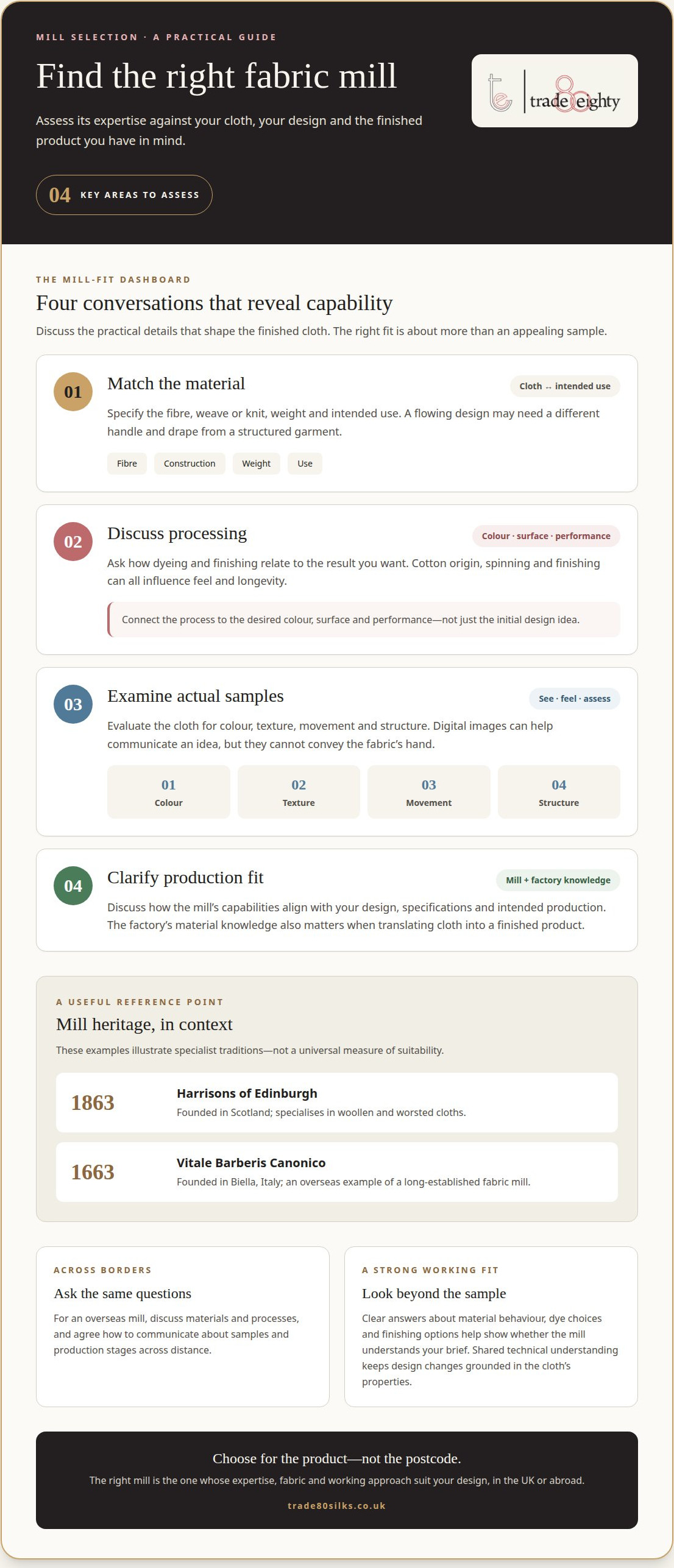
British examples provide useful starting points for understanding specialist capabilities. Harrisons of Edinburgh, founded in 1863, specialises in woollen and worsted cloths. Overseas, Vitale Barberis Canonico, founded in 1663 in Biella, Italy, is another example of a long-established fabric mill. These examples illustrate different traditions, not a universal measure of suitability.
For each prospective mill, discuss the practical details that shape the finished cloth:
- Match the material: specify the fibre, weave or knit, weight and intended use. For example, a flowing design may need a different handle and drape from a structured garment.
- Discuss processing: ask how dyeing and finishing relate to the desired colour, surface and performance. Cotton origin, spinning and finishing can all influence feel and longevity.
- Examine samples: assess the actual cloth for colour, texture, movement and structure. Digital images can help communicate an idea, but they cannot convey fabric’s hand.
- Clarify production fit: discuss how the mill’s capabilities align with your design, specifications and intended production. A factory’s material knowledge also matters when translating cloth into a finished product.
Use these conversations to assess the working relationship, not just the appeal of a sample. Clear answers about material behaviour, dye choices and finishing options can show whether the mill understands your brief. When a design changes during development, shared technical understanding helps keep decisions rooted in the properties of the cloth.
When working with an overseas mill, ask the same questions about materials and processes, and agree how you will communicate about samples and production stages across distance. The right mill is one whose expertise, fabric and working approach suit your product, whether the mill is based in the UK or abroad.
What are typical minimum order quantities for fabric mills?
Fabric mills do not share one standard minimum order quantity. The threshold depends on whether you are selecting cloth already in production or commissioning a new weave, colour or finish. A stocked silk may be available by the cut length, while a custom-dyed or custom-woven fabric needs production planning and material allocation.
For bespoke cloth, the dyeing method and production route can affect the minimum. Preparing a dye bath or setting up machinery for a particular construction may take similar preparation for a small order as for a larger one. The requested colour, fibre, weave and finish all affect what is practical. Ask for the minimum based on your exact specification rather than relying on a general figure for another fabric.
Clarify what the stated minimum measures: it may be a length of fabric, a weight of material or a production batch. These units are not interchangeable. A lightweight silk and a dense wool cloth can yield different lengths from an equivalent weight. Establish whether the quantity applies to each colour or design, or can be divided between options.
- For existing cloth: confirm whether the fabric is available from stock and how much can be allocated to your order.
- For a new colour: ask whether dyeing changes the minimum and whether the same batch can serve multiple design pieces.
- For custom construction: discuss how the weave, fibre and finishing requirements affect production quantity.
Compare the minimum with your product plan. A collection in several colours may require separate quantities, while one colour used across multiple styles could make better use of a production run. Include sampling and anticipated cutting waste in your estimate. Ordering only the finished garment’s fabric requirement can leave too little for production.
For a project requiring a distinctive textile rather than a standard mill run, a bespoke fabric commission offers a route to discuss a tailored specification alongside its practical production requirements.
How much do fabric development, sampling and production typically cost?
There is no single total for developing, sampling and producing fabric. The cost depends on the work involved, from adapting an existing cloth to creating a new construction. Stock fabric avoids some development work, while a custom weave, colour or finish adds processes. A clear estimate separates the stages instead of treating the project as one undifferentiated order.
Development costs reflect the specification and the decisions needed to achieve the desired cloth. Creating a new silk weave, for example, involves different work from selecting an existing silk and adapting its colour. Fibre, yarn, construction, dyeing and finishing all affect the production route. Changes to the brief during development may also require further sampling or revised production preparation.
Ask for the estimate to distinguish these project elements:
- Development: design and technical work for a new weave, colour, print or finish.
- Sampling: preparation of sample cloth, including any dye or finishing trials needed to assess the result.
- Production: fabric quantity, construction, colourways and finishing processes included in the order.
- Additional requirements: any agreed alterations, repeat samples or separate colour developments.
Compare like with like. A quote for an existing fabric in one colour is not directly comparable with one for bespoke cloth in several colourways and a specialised finish. Ask what work each figure covers, whether sample development is separate, and how a specification change affects the next stage. This makes the relationship between design decisions and costs clearer.
Production planning matters too. The quantity ordered, fabric construction and finishing route all shape the overall calculation. A small sample run and a larger production order involve different quantities of cloth and processing. Keep the approved specification consistent across the estimate and order so the colour, weave and finish stay aligned. For bespoke work, clear costing starts with a defined fabric brief and a stage-by-stage breakdown.
What are the steps from requesting a fabric sample to placing a production order
A sample request gives the mill a practical starting point for your design. Describe the intended garment, fibre, colour, finish and preferred handle. Include a reference image or existing swatch if it helps show the result you want. Specific details help the mill select suitable cloth or prepare a relevant sample.
- Define the request. Explain whether you’re considering an existing fabric or developing a new one. Note the intended use and any essential qualities, such as fluid drape, crisp structure or a particular surface finish.
- Assess the sample. Fashion fabrics are tested for drape, weight, movement and structure before garments reach production. Handle the sample, observe it in the intended light and consider how it falls or holds shape. A screen image can’t replace this physical assessment.
- Record refinements. If the sample needs adjustment, describe the difference clearly. For example, specify a softer handle, deeper colour or lighter appearance. Keep each revision tied to the original brief, so feedback remains useful to the mill.
- Approve the specification. Once the fabric meets the design’s needs, record its construction, colour and finish. Use that approved description as the reference for the production order, rather than relying on an informal sample name.
Before ordering, match the approved sample to the final specification. Confirm the selected fabric, colourway, finish and required quantity in the order details. If the design changed during sampling, ensure the production brief reflects those decisions. This links the cloth you assessed with the cloth intended for manufacture.
For a project that calls for a developed textile, discuss your fabric brief and the qualities you want the finished cloth to express.
Trade80Silks UK: Bespoke Fabric Commissions
Trade80Silks UK offers Bespoke Fabric Commissions for designers and manufacturers whose brief calls for a distinctive textile. This is a natural next step when an existing fabric needs adaptation, or when a custom-woven fabric, jacquard, embroidery or digital print better expresses the design.
For projects exploring silk and sheer textures, Crinkle Silk Satin (#167), Printed Silk Organza (PS PEG 5) and Printed Tulle (PS PET 3x) offer different material starting points. The right direction depends on the intended use and the qualities the finished cloth should convey. A clear brief around construction, colour and finish helps shape the commission.
If you’re developing a textile for a specific design, contact Trade80Silks UK to discuss your fabric brief.
Give your fabric idea its next form
Building a relationship with a fabric mill can be part of the creative process, not just a step towards sourcing material. The way cloth catches light, moves across the body or holds a silhouette may inform decisions that were not apparent on a sketch or screen. Treat your fabric brief as an invitation to explore these possibilities, while defining the design’s intended character and use.
Begin with the qualities you want the material to express, whether a fluid drape, a crisp surface or a considered play of colour. A focused conversation can clarify the idea and establish a thoughtful direction for development.
Share your fabric brief with Trade80Silks UK and take the next step towards a textile shaped around your design. Your idea is a fitting place to begin.
Frequently Asked Questions
What information should you include in an initial enquiry to a fabric mill?
Give the mill a concise project brief with enough context to understand the decisions ahead. Explain whether you are developing a concept, preparing a prototype or planning a collection, and include sketches or construction notes where useful. Mention the intended customer and the qualities that matter most. If you need advice on feasibility or fabric behaviour, say so clearly.
How can you build trust and maintain a long-term relationship with a fabric mill?
Building a relationship with a fabric mill relies on dependable communication and a clear record of decisions. Consolidate your feedback, explain why a sample works or falls short, and share changes to the design or production plan early. For a lasting relationship, report how the cloth performed in the finished product. This insight can guide later discussions and decisions.
What are the risks of working with a fabric mill, including delays, defects and changing prices?
A fabric that does not suit the product can create problems, as can a factory’s limited knowledge of the material. Changes to the brief may require further sampling or revised production preparation, which can affect project costs.


