

A silk-printing quote can include more than the printed fabric. The cost of digital fabric printing on silk depends on the fabric, print area and quantity, as well as any separate charges for artwork preparation, sampling or delivery. A sample and a longer production run may therefore be priced differently, even when they use the same design.
Look beyond the headline rate and check what the total includes before setting your project budget. This guide explains how per-metre and minimum-order pricing work, which additional fees may apply, and what to consider when ordering a sample or short run. It also covers how quantity, repeat patterns and fabric choice affect a quote, so you can plan your silk-print project with a clearer understanding of its costs.
Key Takeaways
- Look beyond the headline print rate and account for possible artwork, sampling and delivery charges when planning your budget.
- Understand how minimum quantities and repeat-pattern requirements can shape the size and structure of your order.
- Compare per-metre pricing with per-square-metre quotes carefully, as they describe different measurements.
- Consider a sample or small run to assess how your design and chosen silk work together before planning a larger order.
Digital fabric printing prices and additional fees
A silk-printing quote may cover fabric, print area, artwork preparation, sampling and delivery, rather than one price alone. Before judging the total for a custom fashion design, compare the pricing unit and the work included.
Starting Prices and Printed Product Costs
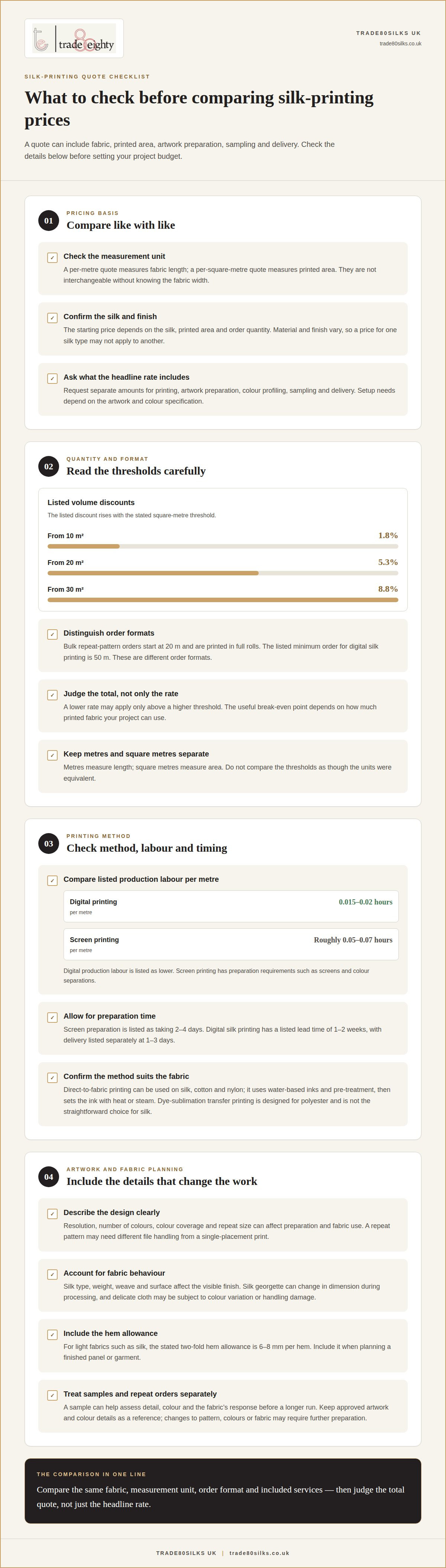
The starting price for custom silk printing depends on the silk, the printed area and the order quantity. Digital-print fabrics also vary by material and finish, so a figure for one silk type won’t necessarily apply to another. For silk satin, establish whether the quote is based on square metres of printed area or fabric length. These units are not interchangeable without knowing the fabric width.
Order volume can affect the rate, with larger runs priced differently from samples. Ask for printing, artwork preparation, colour profiling, sampling and delivery to be itemised. Resolution and the number of colours can affect preparation needs, while a repeat pattern may require different file handling from a single-placement print.
Printing Method and Silk Type
Direct-to-fabric printing can be used on silk, cotton and nylon. It uses water-based inks and pre-treatment to improve absorption, then sets the ink with heat or steam. Dye-sublimation transfer printing is designed for polyester, so it is not compatible with non-synthetic fabrics such as cotton and is not the straightforward choice for silk.
Silk type and weight matter because the weave and surface affect how a design looks. When a printer works with customer-supplied silk, the process needs to suit the cloth, and the quote should account for compatibility and any preparation. Digital printing can reproduce fine details and a broad colour range, but the silk itself influences the visible finish.
Allow for material behaviour as well as print cost. Silk georgette can change in dimension during processing, so usable dimensions may differ afterward. Colour variation and handling damage are practical considerations with delicate cloth; a sample helps assess the design on the intended silk before a larger run.
Timing also has separate stages: digital silk printing has a listed lead time of 1-2 weeks, while delivery is listed at 1-3 days. Keep production and delivery distinct when planning a sample-to-finished-order schedule.
Minimum order quantities and run lengths
Order size affects both the quoted rate and how much fabric you commit to the design. Before choosing a run, compare the minimum quantity, pricing unit and any volume discount.
Order Volumes and Break-Even Points
A lower rate may apply only above a higher order threshold. Compare the total cost of the order, not just the unit price.
Listed volume discounts are 1.8% from 10 m², 5.3% from 20 m² and 8.8% from 30 m². These thresholds help identify where extra quantity may change the overall spend, but the useful break-even point depends on how much printed fabric your project can use.
Setup Fees and Repeat Orders
File preparation and colour profiling may add a setup charge to a first custom-printed order. The charge depends on the artwork and colour specification, so compare setup separately from the fabric and print rate.
For a repeat order with the same design, keep the approved artwork and colour details as a reference. Changes to the pattern, colours or fabric may require further preparation. This helps you plan the repeat without assuming every order will have identical setup needs.
Bulk Pattern Runs and Print Complexity
Bulk repeat-pattern orders start at 20 m and are printed in full rolls, while a listed minimum order for digital silk printing is 50 m. These describe different order formats, so distinguish a repeat-pattern roll from the stated silk-printing minimum when planning your quantity.
Print complexity, colour coverage and repeat size affect artwork preparation and the amount of fabric used in the layout. A dense design with broad colour coverage may need different file preparation from a simple motif. Include the repeat dimensions and colour count in the artwork brief to define the production requirements clearly.
Metres and square metres measure different quantities, so don’t compare these thresholds as though they were equivalent. Environmental considerations may also influence how much surplus fabric you choose to order.
Per-metre digital and screen printing costs
A per-metre quote measures fabric length; a per-square-metre quote measures printed area. Fabric width determines how the figures relate: a metre of narrow cloth contains less printable area than a metre of wider fabric. Before estimating the cost of a clothing or interiors project, compare the pricing unit, fabric width and included finish.
Digital and screen printing also distribute labour and setup differently. Digital printing is listed at 0.015-0.02 labour hours per metre, compared with roughly 0.05-0.07 labour hours per metre for screen printing. This makes digital’s production labour lower, while screen printing carries preparation requirements such as screens and colour separations. Screen preparation is listed as taking 2-4 days.
For a 100 m run, compare the full quote rather than treating the print rate as the only cost. Artwork preparation, colour profiling and sampling may be itemised separately, and their contribution depends on the design and print method. If several designs share a production run, the costing should distinguish shared preparation from work specific to each design, including separate colour separations.
A sample lets you assess detail, colour and the fabric’s response before committing to a longer run. Its quote may include file preparation as well as the printed textile, so compare those costs separately when considering digital and screen printing. Direct-to-fabric digital printing uses water-based inks and pre-treatment to improve absorption.
Finishing also affects the usable dimensions. For light fabrics such as silk, the stated two-fold hem allowance is 6-8 mm per hem. Include that allowance when planning a finished panel or garment, since it uses fabric beyond the visible measurement. Compare the finished format and hem specification alongside print length, weight and method to understand what each per-metre quote covers.
Small-run and sample printing
A sample lets you assess how a particular silk carries a design before committing to production. Direct-to-fabric printing has relatively low setup costs, and small quantities of fabric or garments can be printed at low cost. However, listed silk-printing minimums vary by order format: one price schedule starts at 1 m², while another lists a 50 m minimum. Compare the basis of each quote before planning a short run.
Use a sample to assess fine detail, colour balance and the fabric surface together. A design that looks smooth on screen may appear different across a silk weave, particularly when it contains subtle tones or broad areas of colour. Reviewing a printed test can reveal shade shifts and help you judge whether the finish suits the fabric. It also gives you a practical reference for discussing changes before production.
First-order setup may include file preparation and colour profiling, depending on the artwork supplied. Reusing unchanged files may avoid repeating some preparation, while a revised colour palette or resized motif changes the file requirements. Keep the sample and final artwork formats aligned so the sample can guide production using the intended print layout.
Ask for sample printing, fabric, preparation and delivery to be itemised, then compare those costs with the intended run length. The printing process must suit silk: direct-to-fabric printing uses water-based inks and pre-treatment to support ink absorption. Production facilities, finishing needs and requested accessories can also affect what a sample demonstrates, so define the intended use before approving it.
For a small fashion test, a printed swatch can help assess colour and detail before cutting fabric into clothing. Set the design scale, placement and colour expectations for the sample first; this gives the printer clear criteria for judging whether the result achieves the intended effect. Explore small-run silk printing options for a considered next step.
Trade80Silks UK: Bespoke Fabric Commissions
Trade80Silks UK offers Bespoke Fabric Commissions for designers and makers shaping a distinctive textile brief. This is a natural next step when your project needs a considered silk choice or a custom fabric direction, rather than a standard repeat order. Options include Crinkle Silk Satin (#167), Printed Silk Organza (PS PEG 5) and Printed Tulle (PS PET 3x), each suited to different design intentions and fabric effects.
Share the intended use, artwork and preferred material when outlining your project, so the commission can be approached with its visual and practical requirements in mind. For a tailored discussion of silk and bespoke fabric possibilities, contact Trade80Silks UK.
Shape your next silk project
Let the design’s intended use guide your next decision. Consider how the fabric will move, catch the light and carry colour, then shape the print brief around those qualities. A clear brief connects the cost of digital fabric printing on silk with the material and finish your project needs, rather than treating price as an isolated figure.
For a soft lustre, explore Crinkle Silk Satin (#167); for a sheer, delicate effect, consider Printed Silk Organza (PS PEG 5) or Printed Tulle (PS PET 3x). Each offers a different starting point for a design, from fluid surface to airy transparency.
Bring your preferred fabric, artwork and intended use together as the foundation for a considered commission. Contact Trade80Silks UK about printing to discuss the direction of your silk project, and take the next step with confidence.
Frequently Asked Questions
Are there any additional charges?
Yes. A quote may separate printing from artwork preparation, colour profiling, sampling and delivery. The costs depend on the project: production-ready artwork may need less preparation than a design requiring adjustments or colour work. Ask for each item to be shown separately to distinguish production costs from one-off preparation and delivery charges.
How does order volume impact cost efficiency in each printing method?
Order volume affects digital and screen printing differently because their setup requirements differ. Digital printing can suit shorter runs, while screen printing involves preparation costs that can weigh more heavily on a small order. Compare any fixed setup charge spread across the metres ordered, along with the per-metre rate. The more fabric produced, the smaller the setup cost per metre.
How much does digital fabric printing on silk cost per metre in the UK?
The cost of digital fabric printing on silk per metre depends on the pricing unit and fabric width. Some quotes price printed area in square metres, while fabric may also be priced by length. The usable area per metre depends on the cloth’s width. For a meaningful comparison, identify the unit, width and quantity, then calculate the cost against the length you intend to order.
What are typical setup, sampling and artwork fees for printing on silk?
Setup, sampling and artwork preparation may be itemised separately rather than included in the fabric rate. The work can vary depending on file readiness, colour profiling and whether a sample is needed to assess the design on silk. To read a quote clearly, separate one-off preparation from repeat production, then identify which charges apply again if you revise the artwork.
What file preparation and colour requirements affect the price of digital silk printing?
The cost of digital fabric printing on silk can reflect artwork resolution, repeat dimensions and colour profiling. A fabric-printing guideline recommends preparing images at 200 dpi, while digital silk printing is stated to achieve colour accuracy of ±2 ΔE. Supply artwork at its intended print scale and include a clear repeat size; these details help align the file with the fabric layout and desired colour result.
How do prices compare for direct-to-fabric and transfer printing on silk?
Direct-to-fabric printing can be used on silk and has relatively low setup costs. Dye-sublimation transfer printing is designed for polyester, costs more and is not suitable for silk.


