

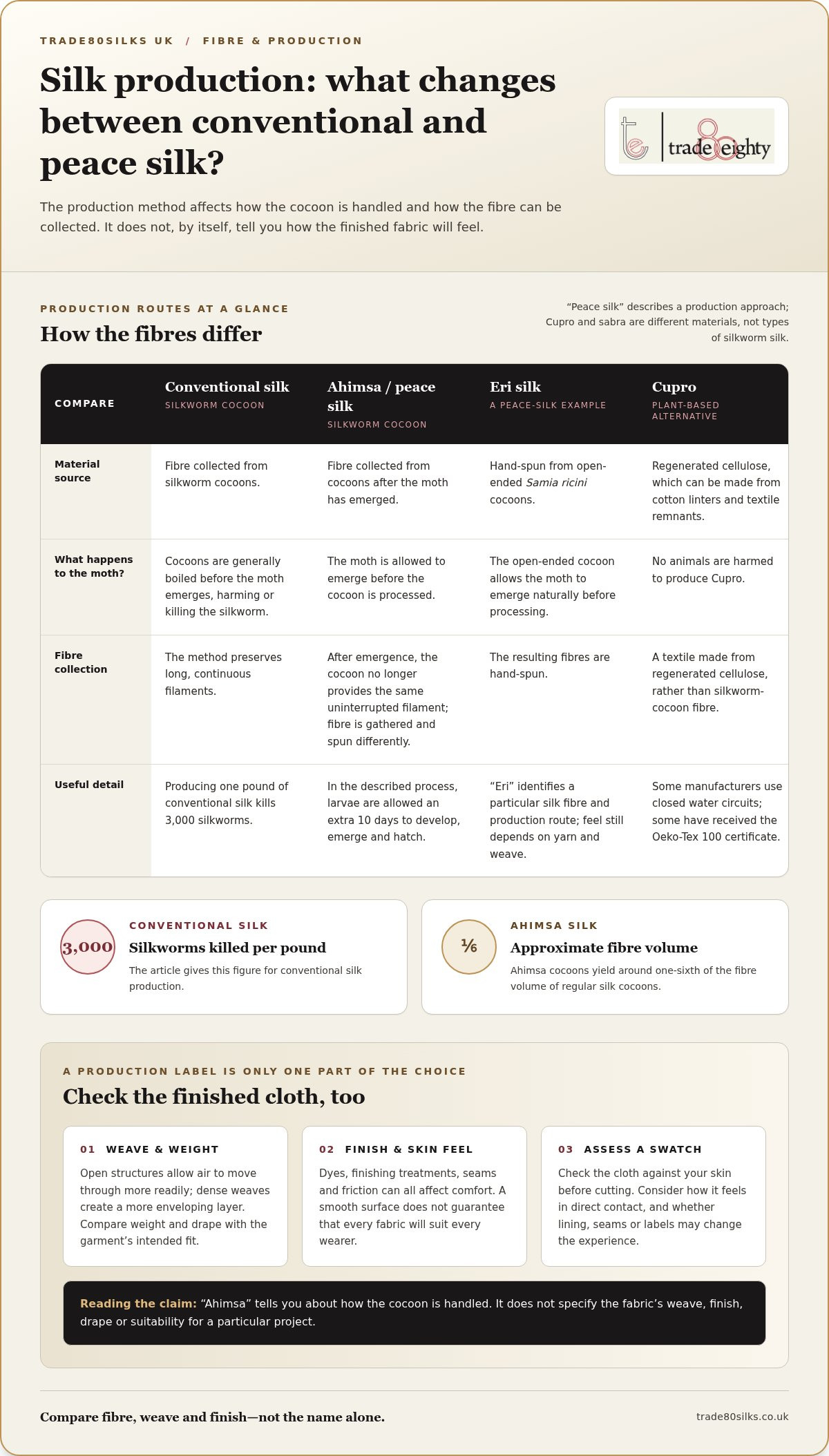
Choosing silk by the metre involves more than colour and drape: the way the fibre is produced matters too. Cruelty-free silk fabric by the metre is often called peace or ahimsa silk. The cocoons are left for the moths to emerge, unlike conventional silk production, where cocoons are generally boiled, harming or killing the silkworm. Eri silk has open-ended cocoons, allowing the moth to emerge naturally before the fibre is processed.
That difference can guide your choice, but the name alone does not tell you how a fabric feels or whether it suits your project. Silk is often valued for its smooth, soft handle, though texture and comfort against sensitive skin vary with the fibre, weave and finish.
Here, you’ll learn how conventional and peace silk production differ, what to consider if you have sensitive skin, and how to assess silk when buying by the metre. Check the fabric’s width and weight alongside its intended use, so you can choose material that works for your project.
Key Takeaways
- Understand how conventional silk production differs from peace silk, and what the term “ahimsa” means in practice.
- Consider weave and finish when judging how a silk fabric may feel against sensitive skin.
- Compare a fabric’s width, weight and intended use to estimate how much you’ll need for your project.
- Explore different silk textures and finishes to find a material that suits your design and creative approach.
Conventional silk production and silkworm deaths
Conventional silk production begins when silkworms form protective cocoons. In the usual process, cocoons are boiled before moths emerge, harming or killing the silkworms. Producing one pound of conventional silk kills 3,000 silkworms. The method preserves long, continuous filaments, but prevents the moths from completing their life cycle.
Ethical production claims depend on how fibres are obtained, not simply on a fabric’s name. “Silk” can refer to materials with different origins, so examine the fibre content and production description. A cruelty-free claim is more informative when it explains whether moths emerge naturally or whether the fibre comes from plants. These distinctions matter when comparing conventional silk with alternatives.
Cupro offers a plant-based textile alternative. Its regenerated cellulose can be made from cotton linters and textile remnants. Some Cupro manufacturers use closed water circuits, and some have received the Oeko-Tex 100 certificate for environmentally friendly production. No animals are harmed to produce Cupro. These details offer useful context, but a certificate or environmental claim describes particular production criteria, not every aspect of a fabric’s impact.
In Morocco, “sabra silk” or “cactus silk” is typically made by hand and appears in street markets in Fez and Marrakech. The name does not mean it comes from silkworms. Eri silk, by contrast, is hand-spun from Samia ricini cocoons, which are open-ended, allowing moths to emerge naturally before processing. For projects requiring a length of fabric, consider Eri’s fibre, weave and intended use rather than assuming every silk alternative has the same texture.
Care and construction also affect the finished textile. Gently hand-wash Eri silk in cold water with mild detergent, avoid harsh wringing, and dry it away from direct sunlight. Before dyeing, test the colour on an offcut; when sewing, match the needle and stitch to the fabric’s weight and weave. These steps help protect delicate fibres and finishes.
Breathability and suitability for sensitive skin
Silk’s breathability depends on its weave, weight and finish, not just its fibre name. Loosely woven silk organza feels different from closely woven satin. Air moves through open structures more readily, while dense weaves create a more enveloping layer. For a summer blouse, compare the cloth’s weight and drape with the garment’s intended fit. A close-fitting lining may feel warmer than a loose outer layer, even when both use silk.
Sensitive skin can respond to more than the fibre. Dyes, finishing treatments, seams and friction all affect how a textile feels when worn. A smooth silk surface may reduce the sensation of roughness, but that does not make every silk fabric suitable for every wearer. Check the fabric’s finish and construction details, then assess a small swatch against your skin before cutting a full garment. This helps you judge whether the particular cloth feels comfortable in direct contact.
Careful comparison also helps when choosing sustainable textiles. Conventional silk and peace silk can feel similar, despite their different production methods. Cupro, made from regenerated cellulose, is another option, with a handle shaped by its weave and finish. Fibre content alone cannot tell you whether a fabric breathes well or feels gentle. Look at the finished cloth, including its surface, density and any coating, rather than relying on a broad label such as “natural”.
For sewing, consider how the fabric will sit against the body. A lined bodice places a barrier between skin and the outer silk; an unlined blouse makes the fabric’s surface more important. Seams and labels can also create rubbing, so plan their placement and finish with care. Handle a swatch, let it rest against the skin, then move naturally to assess its feel. A considered comparison of silk fabric options can help you weigh texture and finish for your design.
Meaning of ahimsa or peace silk
Ahimsa means non-violence, and ahimsa silk is produced using a process that allows the silkworm moth to emerge before its cocoon is processed. In conventional production, cocoons are generally boiled before emergence. Peace silk changes the timing of fibre collection, not the fact that the textile originates from silkworm cocoons.
How is cruelty-free silk produced, and how does it compare with conventional silk? With ahimsa production, the larvae are allowed an extra 10 days to develop into moths and hatch before the cocoons are processed. Conventional silk production usually interrupts that life cycle by boiling the cocoon, preserving a continuous filament.
Once the moth has left, the cocoon no longer provides the same uninterrupted filament. Ahimsa silk cocoons yield around one-sixth of the fibre volume of regular silk cocoons. This helps explain why the fibre must be gathered and spun differently, and why finished peace silk can feel distinct from conventional filament silk. The final handle also depends on the yarn and weave.
Eri silk is a familiar example of peace silk: its open-ended cocoons allow the moth to emerge naturally before processing. The resulting fibres are hand-spun. This distinction is useful when comparing fabric descriptions, since “peace silk” can refer to different production approaches rather than one specific weave or finish. Assess the fabric’s drape, surface and intended use.
Kusuma Rajaiah, a government officer from Andhra Pradesh, was credited with creating and commercialising ahimsa silk. He had 40 years of sericulture experience when he developed it and was 60 years old at the time. His work brought the non-violent production approach into commercial use, illustrating how ethical textile methods can develop through practical knowledge of silk rearing and processing.
For a project requiring a length of fabric, treat “ahimsa” as a clue to how the cocoon is handled, not as a description of the fabric’s overall performance. Compare fibre type, yarn, weave and finish before choosing. A loose weave and a smooth satin, for example, behave differently in a garment, even when both are made from peace silk.
Silk fabric by the metre
Buying by the metre lets you choose a cut length for a specific garment or textile project. Examples include organic Mulberry peace silk at 44 inches wide, and pure Mulberry silk listed at 19 Momme and 45 inches, or 115 centimetres, wide.
Choosing fabric sold by the metre
Fabric sold by the metre is cut to a length you select, rather than supplied only as a finished item. This makes it easier to plan for fashion, a lining or a small design commission. When looking for cruelty-free silk fabric by the metre, compare the sourcing description as well as the cut length. Measure your pattern pieces and allow for hems, seams, print matching and fabric placement.
Width affects how pattern pieces can be arranged, so length alone doesn’t determine what to buy. A 44-inch-wide fabric may require a different cut length from a 59-inch-wide one. Check whether the design has a directional print or nap, since these can limit how pieces are positioned. For a bespoke project, use the intended design and measurements to plan fabric requirements.
Fabric types and weights
Fabric type describes its fibre or construction; weight helps indicate how it may drape and perform. Metre-length examples include Mulberry peace silk, tussar silk and bamboo-print tea silk satin. A handwoven cotton and silk blend is listed at 137 GSM, meaning 137 grams per square metre. Pure Mulberry silk may instead be described by Momme, with one example listed at 19 Momme.
GSM and Momme are not interchangeable: GSM expresses mass per area, while Momme is a silk-specific measure. When comparing cruelty-free silk fabric by the metre, note the stated unit and production description, then consider whether the cloth suits your design. Lightweight, sheer organza behaves differently from satin, regardless of the weight label.
For a practical comparison, note each fabric’s fibre, weave, width and stated weight together. A 45-inch tussar listing and a 59-inch satin listing offer different layout possibilities. Use a paper pattern or measured pieces to estimate length, allowing extra for print matching and cutting. If your design needs a particular width, weave or finish, discuss a bespoke fabric commission as part of planning.
Trade80Silks UK: Crinkle Silk Satin ( #167 )
Trade80Silks UK offers fabric options for designers and makers comparing texture, structure and surface detail for a project. Its Crinkle Silk Satin ( #167 ) provides a satin option, whilst Printed Silk Organza ( PS PEG 5 ), Printed Tulle ( PS PET 3x ) and Printed Silk Devore' ( PS CP8 ) offer distinct material categories to consider alongside your design brief.
Choose according to your project’s needs: fabric type, intended use, desired appearance and how the material will work with your pattern. For a design requiring a particular direction, bespoke fabric commissions offer a way to develop fabric around the project’s requirements. They support fabric selection, but do not determine whether silk was produced using peace-silk methods. Consider production claims separately if cruelty-free sourcing is essential.
Contact Trade80Silks UK to discuss fabric for your project.
Shape your next fabric decision
Let the design guide your final choice: consider how the fabric will move, feel and sit in the finished piece, then weigh those qualities against your sourcing priorities. If cruelty-free silk fabric by the metre is essential, assess production method and fabric performance separately. A beautiful handle alone does not establish how the fibre was produced.
For a project where texture or surface detail is central, Trade80Silks UK offers Crinkle Silk Satin ( #167 ), Printed Silk Organza ( PS PEG 5 ) and Printed Tulle ( PS PET 3x ). These provide distinct materials to consider for your design; ethical sourcing remains a separate consideration when selecting silk.
Bring your intended use, preferred finish and design direction together before choosing a cloth. Contact Trade80Silks UK to discuss fabric for your project and take the next step with clarity and confidence.
Frequently Asked Questions
What does cruelty-free or peace silk mean?
Peace silk describes silk produced using a method intended to let the moth emerge before the cocoon is processed. The practical distinction is how the silkworm is treated, not the fabric’s appearance: two cloths may look similar but come from different production methods. For a garment combining silk panels and lining, consider the sourcing of each silk component separately.
Which UK retailers sell cruelty-free silk fabric by the metre?
Trade80Silks UK supplies fabrics by the metre, with options including Crinkle Silk Satin ( #167 ) and Printed Silk Organza ( PS PEG 5 ). Its range also includes Printed Tulle ( PS PET 3x ), which is polyamide rather than silk. These fabric options have different compositions and uses; assess the specific fibre and production description against your sourcing requirements.
How can I verify a silk fabric is genuinely cruelty-free or peace silk?
Look for a clear account of how the silk was produced, including whether moths were allowed to emerge from their cocoons. Fibre content identifies what the cloth is made from, not how the silkworms were treated. If your design uses several silk fabrics, assess the sourcing information for each one rather than relying on a general claim.
What certifications or labels identify ethical silk fabric?
Read the stated criteria and scope on a label: a textile or environmental certification does not automatically verify animal-welfare practices. A useful claim should explain the production method, including how cocoons are handled and whether moths are allowed to emerge. Treat “ethical” as a broad description, not proof by itself; the specific standard or production details need to address your concern.


