

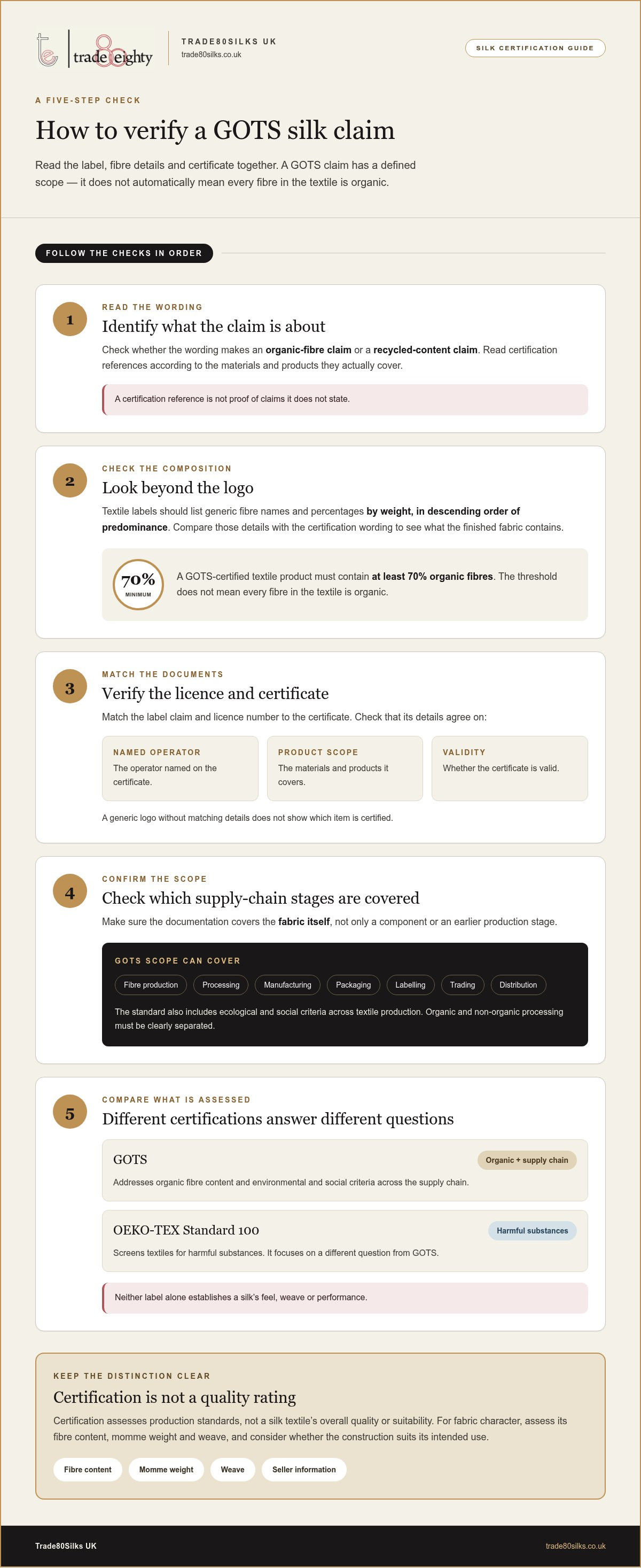
A GOTS label doesn’t necessarily mean every fibre in a silk textile is organic. For GOTS certified organic silk in the UK, the standard requires a textile product to contain at least 70% organic fibres, so the fibre percentages matter as much as the logo.
It’s reasonable to seek certification for reassurance about how a fabric is made, but it helps to understand what that reassurance covers. GOTS addresses organic requirements and environmental and social criteria across the textile supply chain. It does not simply assess the finished silk’s appearance.
This guide explains how the standard applies to silk, what to check in a certification claim and how to assess fabric quality when a textile isn’t certified. It also explains how fibre content, weight and weave can help you make a considered choice.
Key Takeaways
- Read the fibre percentages alongside the certification claim to understand how much of a silk textile is organic.
- Look at which parts of the supply chain a certification covers, from fibre production through processing and labelling.
- Assess silk quality through its fibre content, weight and weave, even when certification is not available.
- Compare the character of woven silk options, including Crinkle Silk Satin, Printed Silk Organza and Printed Silk Devore'.
Is GOTS Certified Silk Always Organic?
No. GOTS requires textile products to contain at least 70% organic fibres, so a certified silk textile may include other fibres. Read the claim and fibre percentages together.
Organic Fibre Standards and Traceability
GOTS links organic fibre content to production and traceability through the textile supply chain. The 70% threshold means certification doesn’t automatically describe every fibre in a finished fabric as organic. Textile labels should list generic fibre names and percentages by weight, in descending order of predominance. Compare those details with the wording of the certification claim to understand what the finished product contains and which material the claim covers.
Eligible Fibres and Certification
Certification references should be read according to the materials and products they cover, rather than treated as proof of claims they do not state. The certificate’s scope and wording show which materials and products it covers. For silk textiles, distinguish an organic-fibre claim from a recycled-content claim, and check the eligible fibre types stated in the certification documents. This distinction matters when comparing mulberry silk with blends or fabrics containing other materials.
Comparing Silk Certifications
GOTS addresses organic fibre content and responsible production across the supply chain; OEKO-TEX Standard 100 screens textiles for harmful substances, according to the OEKO-TEX Association. These certifications answer different questions: one concerns organic status and wider processing criteria, whilst the other focuses on substance safety. Neither label alone establishes the silk’s feel, weave or performance. Compare the exact claim and its scope rather than treating all certified silk as equivalent.
Verifying Certification and Licence Details
To verify a silk product’s GOTS certification, match the label claim and licence number to the certificate’s named operator, product scope and validity. Check that the documentation covers the fabric itself, not just a component or an earlier production stage. A generic logo without matching details doesn’t show which item is certified. There is no single fixed price for silk in the UK: fibre content, weave, finishing and production requirements all affect cost. Compare like-for-like specifications rather than relying on certification alone.
Can a Silk Item Be Good Quality Without a Certification?
Yes. Certification assesses production standards, not the silk’s overall quality or suitability. Clear information about fibre content, momme weight, weave and seller can help you evaluate an uncertified textile.
Environmental and Social Requirements
The Global Organic Textile Standard (GOTS) combines environmental and social criteria across textile production. Its fibre-production requirements follow International Labour Organisation guidelines, while its social criteria address safe working conditions, fair pay and protection against exploitation. Child labour is prohibited. These safeguards matter because a finished silk fabric’s appearance cannot show how workers were treated or how production affected the environment.
Processing Criteria and Certification Limits
GOTS criteria cover processing, manufacturing, packaging, labelling, trading and distribution. Organic and non-organic processing must be clearly separated, and packaging must not contain PVC. The standard also regulates waste treatment. This broad scope goes beyond testing finished fabric, but certification doesn’t guarantee a particular handle, lustre or level of durability.
For uncertified silk, start with its composition and construction. Fibre content identifies what the fabric is made from; momme weight describes its weight, while the weave affects drape and surface character. Tightly woven silk and sheer silk organza suit different design purposes, so judge quality against your intended use rather than a single idea of “best”. Clear seller details also help you understand the material on offer.
Environmental claims deserve the same scrutiny. Terms such as “natural” or “responsible” don’t, by themselves, establish a textile’s production methods or social conditions. Look for specific, substantiated information about the fibres, processing and supply-chain stages being described. A claim about one material or stage shouldn’t be taken as a guarantee about the entire textile.
For a closer look at fabric character, printed silk organza offers a specific woven-silk example to consider alongside the criteria above.
GOTS organic textile standards and supply-chain criteria
GOTS is an international organic textile standard that covers material and processing claims across the supply chain. For silk, its value lies in connecting fibre origin with the handling and manufacture of the textile.
The standard covers requirements from organic fibre growing through processing, dyeing and finishing, then considers workers’ conditions and labelling. Organic fibres must be farmed without genetically modified seeds. A certified product must contain at least 70% organic fibres, so a GOTS claim does not mean every component is organic or that the textile contains 100% organic fibre.
Traceability links the material in a finished fabric to earlier production stages. When comparing silk, check whether certification applies to the complete item, a fabric component or only part of the supply chain. Fibre names and percentages by weight, listed in descending order, clarify what the textile contains. This is especially useful for blends, where silk may be combined with other fibres.
Supply-chain assessments cover processing, manufacturing, packaging, labelling, trading and distribution against ecological and social criteria. Organic textile processing must be clearly separated from non-organic production. This helps distinguish certified material from other goods handled at the same facility.
Independent supply-chain audits can offer another way to examine records and practices across suppliers and processors. They are not the same as a GOTS claim: certification has a defined scope, while an audit’s value depends on the facilities, stages and records it examines. For a considered sourcing decision, compare the certificate’s scope with the textile’s stated fibre content and production chain.
In practice, GOTS is not a single test of finished silk. It is an organic textile framework that covers multiple stages, so the certification’s stated scope is central to understanding what it verifies.
GOTS certification for silk woven fabrics
For silk products, GOTS indicates that organic-fibre and processing requirements apply within the certified product’s stated scope. It addresses production standards, not a promise of a particular weave, handle or finish.
Certification of Woven Silk Fabrics
A woven silk fabric can carry a GOTS claim when the fabric and relevant production stages fall within the certification scope. This matters because a finished cloth goes through more than fibre production: weaving, dyeing and finishing shape its final character. GOTS-certified textiles must meet requirements for organic content and responsible processing. The certification concerns how the material is made, not simply its mulberry-silk appearance.
For fabric buyers, the key distinction is between a certified component and a certified textile. A certificate might cover a particular fabric or only part of its supply chain. Read the claim alongside the product description to see whether it applies to the woven silk itself. This helps prevent a component-level statement from being mistaken for certification of every material or process in a finished item.
What Certification Means for Silk Products
GOTS certification means the product meets organic-fibre requirements and applicable environmental and social criteria within its stated scope. For woven silk fabrics, the standard prohibits harmful dyes, pesticides and toxic chemical finishes. This matters to designers seeking a documented production framework, but the label doesn’t establish the cloth’s quality, appearance or suitability for a particular design.
The global standard connects fibre production with textile processing, including dyeing and finishing. A GOTS claim therefore provides a defined basis for assessing environmental and ethical production, not a complete measure of sustainability. Read certification as evidence that stated criteria have been met, not proof that every impact has been eliminated or that the fabric meets a particular performance specification.
When developing a silk fabric brief, consider the intended weave, colour and finish alongside the certification scope. Discuss a bespoke silk fabric concept to explore how those design requirements can be brought together.
Trade80Silks UK: Crinkle Silk Satin ( #167 )
Trade80Silks UK offers Crinkle Silk Satin ( #167 ) for designers and makers considering silk with a distinctive textured surface. When your brief calls for a different balance of sheerness, pattern or surface detail, Printed Silk Organza ( PS PEG 5 ), Printed Tulle ( PS PET 3x ) and Printed Silk Devore' ( PS CP8 ) offer further material directions.
When a project has specific design requirements, a bespoke fabric commission can help achieve the intended textile character. Certification and fabric quality are separate considerations: assess any certification claim against its stated scope, and consider the fabric’s construction in relation to its intended use.
Contact Trade80Silks UK to discuss fabrics for your design brief.
Shape your next silk sourcing brief
Turn your priorities into a clear fabric brief: describe the intended use, preferred texture, colour direction and any certification requirements. When sourcing GOTS-certified organic silk in the UK, distinguish the certification’s scope from the qualities you want in the finished cloth. That way, your sourcing decisions can meet your standards and serve your design.
Trade80Silks UK offers Crinkle Silk Satin ( #167 ), Printed Silk Organza ( PS PEG 5 ) and Printed Tulle ( PS PET 3x ), each offering a different material direction for creative work. These examples can help you frame a conversation around the character of the fabric you’re seeking, without treating a product name as evidence of certification.
Contact Trade80Silks UK to discuss sourcing and take your next design brief towards a considered choice of fabric.
Frequently Asked Questions
Why Do Some Silk Products Mention Hypoallergenic and Certifications Together?
“Hypoallergenic” describes a comfort claim, while a certification identifies criteria a product or its production has met. The terms may appear together in marketing, but one doesn’t prove the other: a textile safety certification doesn’t establish that every wearer will find silk comfortable. Assess each statement separately, and look for specific evidence behind claims about substances, organic content or manufacturing.
Are there GOTS-certified organic silk brands or retailers in the UK?
A search for “GOTS certified organic silk UK” may return both fabric suppliers and retailers of finished goods, but a brand name alone doesn’t establish that a particular silk item is certified. Trade80Silks UK supplies silk and natural fabrics for designers and manufacturers. Assess any certification claim against documentation for the specific fabric or item, rather than assuming that every product in a range shares the same status.
Which UK shops sell GOTS-certified organic silk bedding, clothing, or accessories?
This sourcing guide doesn’t provide a verified shop directory for finished bedding, clothing or accessories. Distinguish those products from fabric sold by the metre for design and manufacture: they are different purchases with different documentation. For a finished item, assess the certification claim against its label and supporting paperwork. A retailer’s general statement about organic materials doesn’t establish the status of every product.
Does GOTS certify silk fibre, finished products, or both?
GOTS applies to organic textile products and evaluates relevant production stages, rather than certifying a fibre in isolation. A claim may cover a finished textile, a fabric component or a defined part of its supply chain. For example, silk fabric used in a garment and the completed garment are distinct items, so the certification scope determines what the claim covers.
Are GOTS-certified silk products available from UK manufacturers or suppliers?
UK designers can source silk fabrics from suppliers, including Trade80Silks UK, which offers materials such as silk organza and crinkle silk satin. Supplier location or product category doesn’t itself establish GOTS status. For a sourcing decision, distinguish the supplier’s fabric offering from a certification claim, which needs to correspond to the particular product and its documented scope.
What should UK buyers check before purchasing GOTS-certified organic silk?
For searches such as “GOTS certified organic silk UK”, focus on the details behind the claim. Compare the exact item named, its fibre composition, certification scope and supporting documents. Check whether the paperwork refers to the fabric itself or a finished item, and whether the label identifies a blend. Assess construction and intended use separately, since certification doesn’t determine the texture, drape or suitability you need.


