

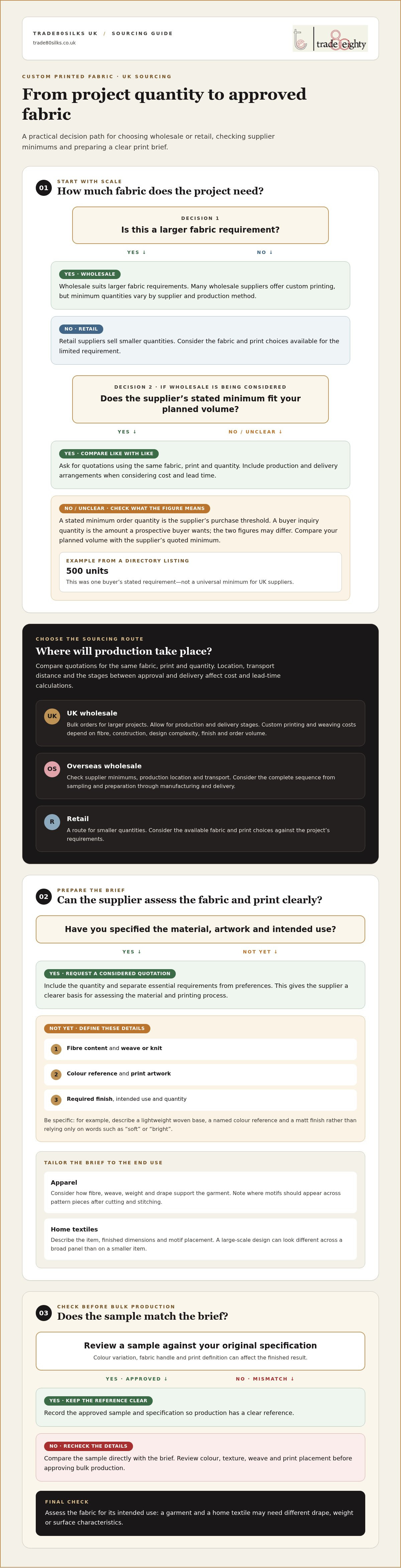
Yes, many wholesale fabric suppliers offer custom printing, making custom fabric sourcing in the UK a practical route when you need larger quantities for a collection or interior project. Wholesale suppliers sell in bulk to businesses and individuals, and one UK printed-fabric directory buyer listing specified a requirement of 500 units. That figure is a listing requirement, not a universal minimum.
Choosing between wholesale and retail depends on the scale of your project: retail suppliers sell smaller quantities, while wholesale suits larger fabric requirements. Before settling on a print and base cloth, it helps to know which route fits your apparel or home-textile project. This guide explains how custom printing fits into wholesale sourcing, compares wholesale and retail, and covers practical considerations for choosing fabric. You’ll be better placed to match the quantity, material and print approach to your design.
Key Takeaways
- Wholesale suppliers can offer custom printing, but minimum order quantities vary; assess the required volume against your project before choosing a route.
- Match the fabric and print approach to the intended use, whether you’re developing apparel or home textiles.
- Compare wholesale and retail sourcing by quantity needs and the level of customisation your design calls for.
- Explore Trade80Silks UK’s silk options, including Crinkle Silk Satin, when your project calls for a distinctive fabric with a considered finish.
Can I order custom printed fabrics from wholesale fabric suppliers?
Yes, many wholesale fabric suppliers offer custom printing, although minimum quantities depend on the supplier and production method. A UK printed-fabric directory buyer listing specified a requirement of 500 units, which illustrates one inquiry rather than a universal minimum.
Minimum and Inquiry Order Quantities
Wholesale suppliers sell in bulk to businesses and individuals who need larger fabric quantities. A stated minimum order quantity sets the purchase threshold, while a buyer inquiry quantity is simply the amount a prospective buyer wants. These figures may differ, so compare your planned volume with the supplier’s quoted minimum.
For instance, the directory listing’s 500-unit requirement signals a buyer’s requested quantity, not a rule for every UK supplier. Custom printing may also involve production setup, making the requested quantity relevant to the supplier’s quotation.
UK and Overseas Sourcing
UK and overseas sourcing differ in production location, transport distance and the steps between approval and delivery. These factors affect total cost and lead-time calculations, so compare quotations for the same fabric, print and quantity.
In the UK, custom printing and weaving costs depend on fibre, construction, design complexity, finish and order volume. Lead times depend on sampling, preparation, manufacturing and delivery arrangements, so consider the whole sequence rather than one production stage.
Briefing a Fabric Supplier
Give the supplier a clear specification: fibre content, weave or knit, colour reference, print artwork and required finish. For example, specify a lightweight woven base, a named colour reference and a matt finish instead of relying on descriptions such as “soft” or “bright”.
Include the intended use and quantity, and separate essential requirements from preferences. This helps the supplier assess the material and printing process against your design and makes quotations easier to compare.
Sourcing Risks and Quality Checks
Colour variation, fabric handle and print definition can affect the finished result. Before approving bulk production, review a sample for colour, texture, weave and print placement, and compare it directly with your original brief.
Assess the fabric for its intended use, too. A garment and a home textile may need different drape, weight or surface characteristics. Record the approved sample and specification so production has a clear reference.
| Option | Quantity basis | Cost and timing factors | Best fit |
|---|---|---|---|
| UK wholesale | Bulk orders | Production and delivery stages | Larger projects |
| Overseas wholesale | Supplier minimums | Production location and transport | Projects suited to overseas production |
| Retail | Smaller quantities | Available fabric and print choices | Limited requirements |
Choose a supplier whose minimum, material specification and production route suit your quantity and intended use.
Apparel and home-textile sourcing
For apparel, consider how the fabric’s fibre, weave, weight and drape support the garment design. For home textiles, focus on the intended item and how its surface, structure and print will look and be handled.
Choosing fabric for apparel
Start with the garment: a flowing blouse and a structured jacket call for different fabric behaviour. Specify the fibre and weave, then consider how the cloth falls, feels and moves. The custom print should suit the garment’s pattern pieces, too, so note where motifs need to appear after cutting and stitching.
For example, a repeat pattern for a dress may need careful placement across the bodice and sleeves. Share a sketch or reference image with the artwork, and identify your preferred colours and finish. This gives the supplier a clear brief to assess against the fabric’s intended use.
Choosing fabric for home textiles
For a cushion cover, curtain or decorative panel, describe the item and the visual effect you want. A large-scale motif can look different across a broad panel than on a smaller item. Include finished dimensions and placement preferences in the brief instead of sending artwork without context.
Ask for a sample when evaluating colour, surface and handle. Some wholesale fabric suppliers offer samples free or for a small fee. Comparing a sample with your design references helps you judge whether the fabric’s texture and print work together for the intended interior, such as when coordinating bespoke soft furnishings with dining pieces from Grosvenor Furniture.
For UK rules and labelling, keep fibre-composition details, care information and origin claims distinct in your product records. Consider imported and UK-manufactured textiles alike, and prepare label information for the finished item. A fabric specification alone is not a complete product label.
Once the use, fibre, weave, colour and finish are defined, a supplier can assess the brief more precisely. For designs that call for silk, explore printed silk fabric options as a reference for material and print direction.
UK wholesale fabric suppliers
UK mills, textile manufacturers and wholesale suppliers meet different needs, from developing cloth to sourcing existing fabric. For sustainable or certified options, define the material or claim you need, then assess the supporting documentation and what it covers.
Fabric Mills and Textile Manufacturers
UK fabric mills and textile manufacturers may suit projects requiring custom production rather than a print applied to existing stock. Capabilities differ by fibre, weave, finishing process and production method, so match your brief to the work required.
For example, a design that requires a particular woven structure calls for a different production discussion from a custom print on a chosen base cloth. Set out the fibre, construction, colour and finish first to give the manufacturer a clear basis for assessing your request.
Custom Fabric Samples and Swatches
Samples and swatches help compare a fabric’s colour, texture and handle before selecting material for a larger project. Some wholesale suppliers offer samples free or for a small fee, giving buyers a way to assess the cloth in person.
Compare each swatch with the design reference in the conditions where it will be used. For apparel, examine drape and surface. For home textiles, consider how the weave and print look across the intended area.
To source sustainable or certified fabrics in the UK, identify the exact material or production claim your project requires. Review documentation supporting that claim, checking which fibre, process or stage it covers instead of relying on a broad description.
Use a structured shortlist to compare UK suppliers. Note whether each offers existing stock, custom printing, weaving or other production, then record sample options and relevant documentation. This helps distinguish fabric development from print customisation and align the sourcing route with your design.
Before choosing a supplier, organise your brief into essential specifications and preferences. Include a reference image or artwork, intended use, fibre, weave, colour and finish, then compare the sample with those details. This makes differences in material and appearance easier to assess.
Wholesale versus retail suppliers
Choose between wholesale and retail based on how much fabric your project needs. UK retail suppliers sell smaller quantities, while wholesale is geared towards larger fabric requirements.
For a single garment or small home project, retail quantities may suit your plan. A designer developing a repeat collection may need more material, making wholesale worth comparing. The right route depends on total quantity, whether the design is custom printed, and how consistently the fabric must match across pieces.
Customisation is separate from the sales channel. Some wholesale suppliers offer custom printing, while retail focuses on smaller quantities. If your project needs a bespoke print, consider the amount of fabric required and whether the production route suits that scale. A short run and a larger collection may call for different sourcing choices. Similarly, if your project centres on finished garments rather than raw textile yardage, dedicated custom apparel and merchandise services such as rawmerch.co.uk offer a practical route for UK printing.
| Option | Typical buyer | Quantity fit | Decision point |
|---|---|---|---|
| Wholesale supplier | Designers or larger fabric buyers | Bulk requirements | Compare the minimum with the project total |
| Retail supplier | General public | Smaller fabric needs | Assess whether the available amount suits the design |
Use a simple decision guide: estimate the fabric needed for every planned item, then separate essential material requirements from preferences. For example, someone making one sample garment can compare retail quantities with the fabric needed for testing. A designer planning repeated pieces can assess wholesale against total production needs.
Finally, compare the same fibre, weave, colour and finish across both routes. This makes the differences easier to judge without mistaking a different specification for a better value. If a bespoke design calls for a tailored fabric approach, explore bespoke fabric commissions for a route centred on custom fabric development.
Trade80Silks UK: Crinkle Silk Satin ( #167 )
Trade80Silks UK is a natural next step when your design calls for considered silk fabrics or a bespoke fabric commission. For projects where the material and print must work together, its selection includes Crinkle Silk Satin ( #167 ), Printed Silk Organza ( PS PEG 5 ), Printed Tulle ( PS PET 3x ) and Printed Silk Devore' ( PS CP8 ).
Choose according to the character of your design and the fabric you want to develop. A bespoke commission offers a route for discussing a custom fabric brief, whilst the named printed fabrics provide specific options to consider for your project. Share your intended use, artwork and material preferences when outlining what you’re creating.
Please contact Trade80Silks UK to discuss your fabric requirements.
Shape your next fabric direction
A thoughtful approach to custom fabric sourcing in the UK can start with one creative decision: which material best expresses your design? A cloth’s drape, surface and response to light influence how a finished piece feels and looks, so let those qualities guide your next brief.
Trade80Silks UK offers Crinkle Silk Satin ( #167 ), Printed Silk Organza ( PS PEG 5 ) and Printed Tulle ( PS PET 3x ). These options provide distinct starting points for designers developing work with silk and printed textiles. Bring together your intended use, preferred material and visual direction, then explore which fabric aligns with the piece you have in mind.
Contact Trade80Silks UK to discuss your fabric requirements and take the next step towards a thoughtfully realised design.
Frequently Asked Questions
Which companies offer custom fabric sourcing in the UK?
Trade80Silks UK is one UK source for fabric supply and bespoke textile development. Its bespoke work includes custom-woven fabrics, jacquards, embroideries and digital prints, making it relevant when a design needs more than an off-the-shelf cloth. For example, a designer can develop a brief around a particular weave or surface treatment, then align the fabric direction with the intended collection.
What are the minimum order quantities for custom fabric in the UK?
There is no single minimum order quantity across UK custom fabric suppliers. Requirements can differ between printing onto existing fabric and developing a custom weave, as each route involves different production needs. Separate sample or trial requirements from your planned production order, and state the total quantity and fabric specification clearly. This helps distinguish an initial buyer inquiry from a confirmed order.
Lead times for custom fabric production in the UK
Lead times depend on sampling, preparation, manufacturing and delivery arrangements. Compare quotations on the same fabric, print and quantity basis.


