

The smallest collection can be the hardest to source: custom fabric can require far more yardage than a new label needs. A practical approach to fabric sourcing for small fashion brands in the UK is to consider stock-service textiles, where orders may be as low as 10-50 metres, alongside bespoke runs that can require 1,000 to 3,000 metres per colourway.
Choosing fabric means looking beyond how it feels. Consider how it will be cut, sewn and finished, and whether the available quantity and supply plan suit your collection. This guide explains how to assess UK fabric suppliers, compare stock and bespoke options, and prepare specifications for sampling and production. It also covers trims, so fabric and finishing details work together in the garments you plan to make.
Key Takeaways
- Match supplier selection to your garment’s construction, finish and production schedule, then assess samples for drape, shrinkage and colour consistency.
- Balance minimum order quantities against realistic collection needs so surplus cloth doesn’t tie up budget or remain unused.
- Write a clear material brief covering fibre content, weight, colour, finish, stretch and intended garment to make supplier discussions more precise.
- Plan fabric and trim sourcing together, and consider bespoke fabric commissions when a collection calls for a more distinctive material.
Finding UK fabric suppliers that match a collection’s requirements
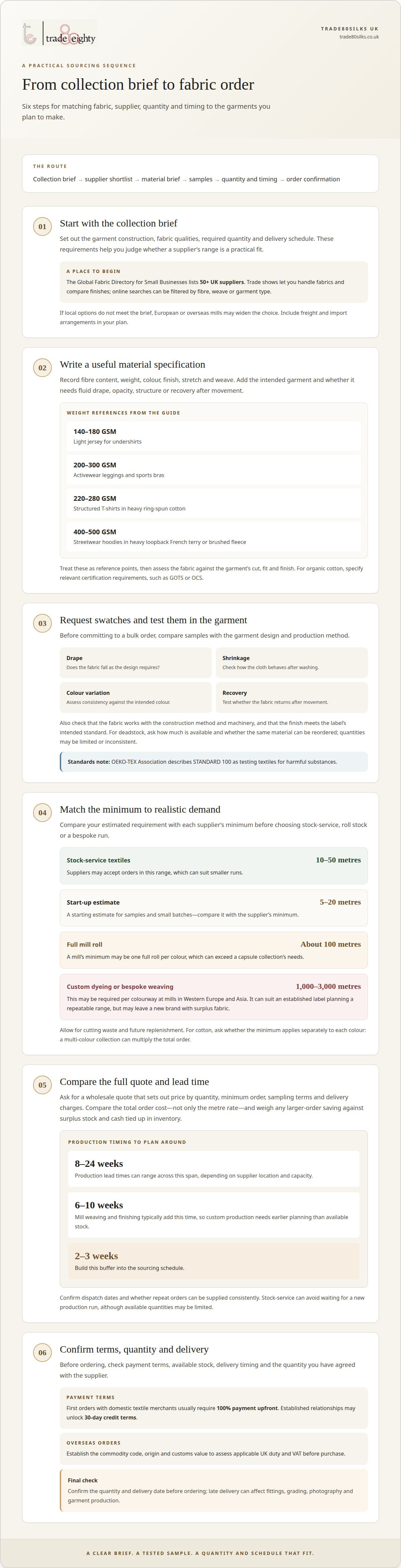
Start with the collection brief: garment construction, fabric qualities, required quantity and delivery schedule. The Global Fabric Directory for Small Businesses lists 50+ UK suppliers, offering a starting point for wholesale enquiries.
Supplier discovery routes
Trade shows let you handle fabrics, compare finishes and speak with suppliers; online searches make it easier to filter by fibre, weave or garment type. Shortlist UK merchants whose ranges suit your collection, then ask about minimum order quantities, stock and repeat availability. If local options do not meet your brief, European or overseas mills may widen the choice. Include freight and import arrangements in your plan.
Quality and reliability checks
Request samples before committing to a bulk order, then test drape, shrinkage, colour variation and recovery against the garment design. Check that the fabric works with the construction method and machinery, and that the finish meets the label’s intended standard. Deadstock and recycled fabrics can be found through surplus-stock specialists and textile merchants; ask about the quantity available and whether the same material can be reordered. Deadstock may be limited or inconsistent, while relying on one supplier leaves a collection exposed to stock or delivery disruption. OEKO-TEX Association describes STANDARD 100 as testing textiles for harmful substances.
Payment terms and sourcing timelines
First orders with domestic textile merchants usually require 100% payment upfront; established relationships may unlock 30-day credit terms. Build a 2- to 3-week buffer into the sourcing schedule, and confirm delivery dates before sampling begins. Mill weaving and finishing typically add 6-10 weeks, so custom production needs earlier planning than available stock. Late delivery can affect fittings, grading, photography and garment production.
Fabric specifications and supplier questions
Give suppliers a clear specification covering fabric type, fibre content, weight, colour, finish, stretch and intended garment. Ask whether the minimum order suits your needs, whether the fabric is in stock and when it can be delivered. For overseas orders, establish the commodity code, origin and customs value to assess applicable UK duty and VAT before purchase. A practical sequence is to share your brief, request swatches, test them in the garment, then confirm quantity and delivery before ordering.
Minimum order quantities and stock-service textiles
For a small collection, minimum order quantities can shape fabric choice as much as colour or handle. Stock-service fabrics may suit limited runs; custom production usually calls for greater commitments and longer planning.
Minimums for small collections
Stock-service suppliers may accept orders of 10-50 metres, giving emerging labels room to sample and produce smaller quantities. Start-ups often estimate needs of 5-20 metres for samples and small batches, then compare that estimate with each supplier’s minimum order. A mill’s minimum may be one full roll, approximately 100 metres per colour, which can exceed a capsule collection’s requirements.
Custom dyeing or bespoke weaving can require 1,000 to 3,000 metres per colourway at mills in Western Europe and Asia. That scale may suit an established label planning a repeatable range, but it can leave a new brand holding surplus fabric. Match the commitment to realistic demand, allowing for cutting waste and future replenishment. If the fabric is cotton, ask whether the minimum applies separately to each colour, since a multi-colour collection can multiply the total order.
Pricing, lead times and trade discounts
Fabric prices depend on quantity, material and whether the textile is stocked or made to specification. Request a wholesale quote that sets out the price by quantity, minimum order, sampling terms and delivery charges. Compare the total order cost, not just the metre rate. Larger orders may have different price terms, but weigh any saving against surplus stock and cash tied up in inventory.
Production lead times can range from 8 to 24 weeks, depending on supplier location and capacity. Stock-service textiles can avoid waiting for a new production run, although quantities may be limited. Ask when the order can be dispatched and whether repeat orders can be supplied consistently. For a trade discount, establish the qualifying quantity and whether it applies across one fabric or a combined order; this helps forecast the true cost of the collection.
Sourcing consultation and material specifications
For small fashion brands in the UK, fabric sourcing starts with a clear technical brief that turns a garment concept into practical material criteria. A focused discussion can then explore how those requirements fit the garment’s construction and intended use.
Record the fibre content, weight, colour, finish, stretch and weave. Add the garment type and whether it needs fluid drape, opacity, structure or recovery after movement. “Soft cotton” leaves room for interpretation; “structured cotton jersey for a T-shirt” gives a supplier a more useful starting point. For organic cotton, specify relevant certification requirements, such as GOTS or OCS.
Weight helps distinguish fabrics with different purposes, but it doesn’t determine suitability alone. Light jersey for undershirts is given as 140-180 GSM, whilst structured T-shirts are described as 220-280 GSM heavy ring-spun cotton. For streetwear hoodies, heavy loopback French terry or brushed fleece is specified at 400-500 GSM. Activewear leggings and sports bras commonly use 200-300 GSM. Treat these as reference points, then assess the cloth against your garment’s cut, fit and finish.
Ask suppliers for production-relevant details: fibre composition, fabric width, finish, stretch behaviour and care requirements. Clarify whether the stated weight applies to the finished fabric and whether a colour or finish changes its handle. For woven material, describe the desired weave and surface; for jersey, specify the stretch and recovery your pattern requires. These details help ensure the swatch represents the fabric you will use in production.
A fabric sourcing plan for small fashion brands in the UK can address design trade-offs before sampling. A crisp weave may support a tailored silhouette, while a fluid material may create a softer drape. Share the garment sketch, intended finish and production method, then assess swatches in context. A precise brief and clear feedback can also support supplier relationships and future fabric development.
Fabric and trim sourcing for UK fashion brands
Include fabric and trim sourcing in product development before finalising a collection. This gives UK brands time to identify availability, minimums and production constraints before committing to samples or bulk manufacturing. If suitable cloth is unavailable locally, sourcing can extend to suppliers in Europe, Turkey or China. Assess each option by how well its full production plan fits, not by country of origin alone.
A UK supplier can make it easier to review materials quickly or visit a mill or manufacturer in person. Sample cuts are typically 1-5 metres, and sample meterage may cost 30-50% more than bulk prices. Build sample costs into development planning, then assess the cloth in the intended garment before approving production. A 5-10% wastage buffer can also help account for cutting needs when estimating bulk quantities.
For sustainable fabrics, match material claims to appropriate documentation. Organic cotton guidance names GOTS and OCS, while recycled polyester guidance recommends checking GRS documentation. The same guidance advises ensuring domestic and imported textiles comply with UK REACH regulations. Keep relevant supplier documents with each fabric specification so the material and its supporting records remain clear throughout production.
Source trims alongside fabric, considering how each component will work with the garment’s colour, finish and construction. A fastening or lining that arrives separately can affect the production sequence, so include trim requirements in the collection brief and align delivery plans. Fabric accounts for 60% to 70% of a garment’s total cost, making material choices consequential for costing. For a distinctive textile requirement, discuss a bespoke fabric commission as part of the sourcing plan.
Trade80Silks UK: Bespoke Fabric Commissions
Trade80Silks UK is a natural next step when a collection needs a textile developed around a particular design direction. Its Bespoke Fabric Commissions include custom-woven fabrics, intricate jacquards, embroideries and digital prints, bringing specific surface detail or pattern ideas into the material itself.
For designers considering silk, the existing selection includes Crinkle Silk Satin ( #167 ), Printed Silk Organza ( PS PEG 5 ) and Printed Tulle ( PS PET 3x ). These offer distinct starting points for exploring texture, transparency and printed effects within a collection. A commission may be especially relevant when standard stock doesn’t express the intended finish or visual character. Share your fabric brief and collection requirements with Trade80Silks UK to begin a conversation about a bespoke fabric commission.
Give your collection a distinctive material direction
As your collection develops, treat fabric choice as part of its creative identity, not simply a production decision. A considered approach to fabric sourcing for small fashion brands in the UK can help translate a design idea into material with the right character, finish and role in the range.
Trade80Silks UK’s selection includes Crinkle Silk Satin ( #167 ), Printed Silk Organza ( PS PEG 5 ) and Printed Tulle ( PS PET 3x ), each offering a different starting point for exploring texture and visual expression. Where your concept calls for a more individual textile, a Bespoke Fabric Commission can bring a specific creative direction into focus.
Share the material qualities and design intent you have in mind with Trade80Silks UK to discuss sourcing. Your next collection can begin with a fabric choice that feels considered, cohesive and distinctly your own.
Frequently Asked Questions
Which UK fabric suppliers offer low minimum order quantities or no minimums?
UK stock-service fabric suppliers are the most practical starting point for smaller orders; some accept orders of 10-50 metres. Minimums and availability vary by fabric and colour, so a no-minimum option isn’t universal. For a specific collection, compare the supplier’s order threshold with the quantity needed for sampling, production and any planned replenishment before choosing a textile.
What are typical wholesale fabric prices per metre in the UK?
Wholesale prices per metre vary by fibre, weave, finish, quantity and whether the fabric is stocked or made to order. Compare quotes against the same specification, including width and composition, to ensure they cover equivalent material. Include sampling, delivery, minimum quantities and likely wastage in your costing. A lower metre price does not necessarily mean a lower total order cost.
How do fabric MOQ, lead time and sampling options compare between UK suppliers?
Stock-service suppliers may accept 10-50 metres, while custom fabric production can take 8-24 weeks, depending on supplier location and capacity. Sample cuts are typically 1-5 metres, which lets a brand assess fabric before committing to production. Compare these terms together: a short sample stage is useful only if the available quantity and delivery schedule can also support the collection.
How can a small brand assess fabric quality, composition and colourfastness before ordering?
Order a sample and assess it under conditions the finished garment will encounter. Compare its colour in consistent lighting, inspect the surface and weave, and test a discreet piece for colour transfer with a clean, damp cloth. Match the composition in the supplier’s technical information to the intended garment, then assess drape, stretch and recovery during construction trials.
What are UK import duties, VAT and customs rules for importing fabric?
Before purchasing, establish the fabric’s commodity code, origin and customs value to assess applicable UK duty and VAT.
Which UK suppliers offer deadstock, recycled or sustainable fabrics?
Deadstock and recycled fabrics may be available through surplus-stock specialists and textile merchants. Ask about available quantities and repeat availability, and check relevant documentation, such as GOTS or OCS for organic cotton and GRS for recycled polyester.


