

Silk’s natural origin doesn’t make every silk supply chain sustainable. Conventional production involves boiling silkworms before they emerge, while peace silk uses cocoons after the moths have emerged. For buyers seeking an ethical silk supplier in the UK, this distinction is an important starting point. Sustainability also depends on how the fibre is produced and on the people involved.
Silk’s lustre, drape and durability make it a treasured material, but choosing responsibly means looking beyond appearance. This guide explains how silk’s environmental impact and silkworm welfare can vary, and how to assess information about artisan wages and OEKO-TEX certification when comparing suppliers.
These practical considerations can help you weigh the factors together, understand what a certification does and doesn’t tell you, and consider it alongside sourcing and production details. The result is a clearer basis for choosing silk that suits your creative work and your standards.
Key Takeaways
- Assess silk’s sustainability across its production, not simply by its natural origin or luxurious feel.
- Distinguish conventional silk from peace silk by whether silkworms can emerge naturally from their cocoons.
- Look for clear information about artisan pay and working conditions, alongside the provenance of the fabric.
- Use OEKO-TEX certification as one part of your assessment, while considering separately what it says about worker welfare and wages.
- Bring fibre, welfare, labour and certification details together to make a more informed choice for your project.
How sustainable is silk?
Silk’s sustainability depends on its production, including silkworm welfare, processing and labour. Compare evidence about each stage rather than relying on a broad ethical label.
Ethical and conventional silk production
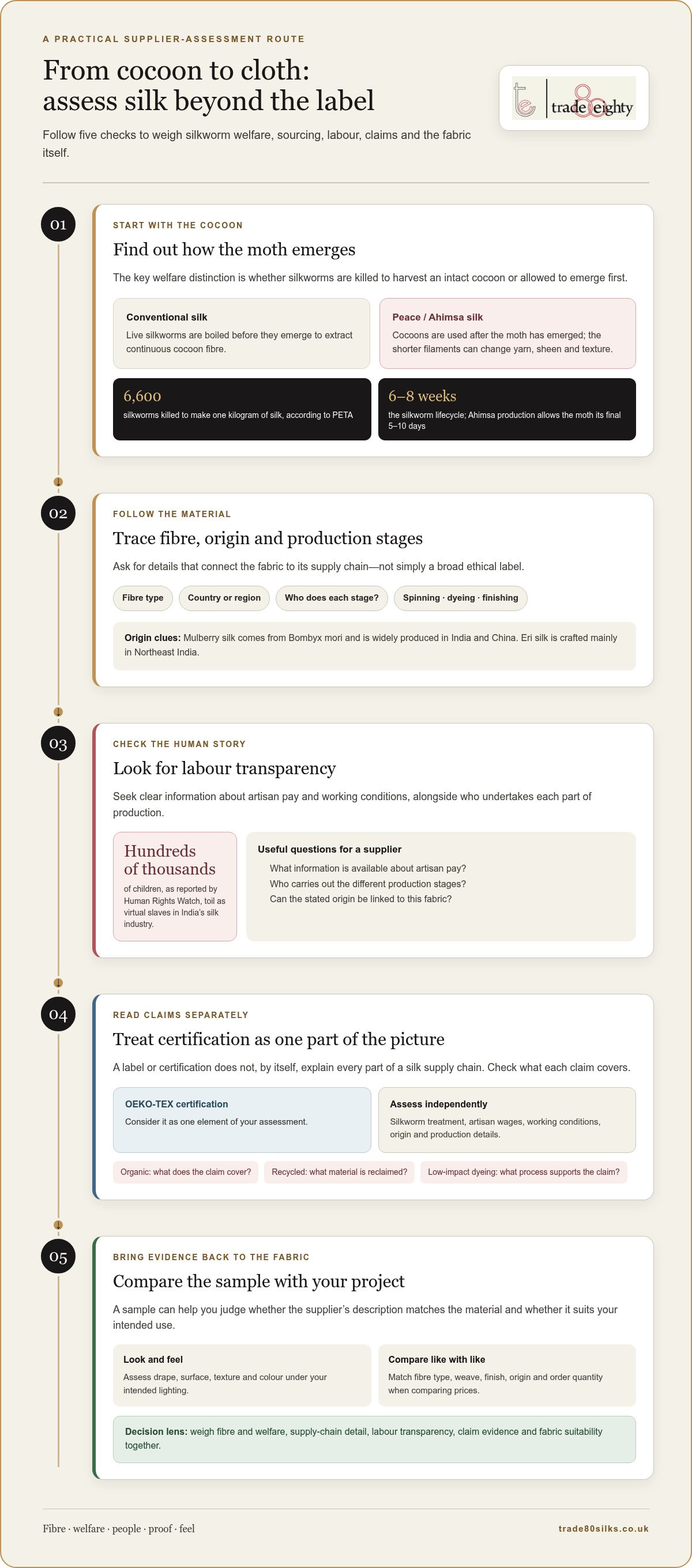
Conventional mulberry silk comes from the Bombyx mori silkworm, which feeds primarily on mulberry leaves. Another Tomorrow identifies boiling live silkworms to extract continuous cocoon fibre as a feature of conventional silk supply chains. PETA states that 6,600 silkworms are killed to make one kilogram of silk. This makes animal welfare a material consideration alongside the fabric’s appearance and durability.
Peace silk uses cocoons left after moths emerge, so the larvae aren’t killed to harvest the fibre. The silkworm lifecycle lasts around 6-8 weeks, and Ahimsa production allows silkworms to leave the cocoon and live their final 5-10 days. Shorter peace-silk filaments can affect the yarn, sheen and texture.
Compare fabrics, quality and origin
UK suppliers may offer different silk types, weaves, finishes and origins. Mulberry silk is produced by Bombyx mori and widely produced in India and China; Eri silk is crafted mainly in Northeast India. An ethical silk supplier in the UK should clearly describe fibre type and production origin, so you can compare like with like.
Quality also depends on construction and appearance, not a label alone. Peace silk has a subtler sheen than classic silk, and its shorter filaments affect the resulting yarn. Request samples where available, then assess drape, surface and colour under your intended lighting. Fabric prices depend on type, weave, finish, origin and order quantity, so compare matching specifications rather than headline prices.
Check claims, labels and supply chains
Distinguish fibre-composition details from sustainability claims in UK textile descriptions. Read the stated material information, then assess environmental or ethical wording separately. The word “ethical” alone doesn’t explain silkworm treatment, origin or artisan pay. When comparing an ethical silk supplier in the UK, look for production details that connect each claim to the fabric and its supply chain.
Trace the route from fibre and spinning through dyeing and finishing. Note the country or region and who undertakes each stage. Human Rights Watch reported that hundreds of thousands of children toil as virtual slaves in India’s silk industry, making labour transparency important. For a first assessment, request a sample and compare its finish with the supplier’s written description.
Organic, recycled and low-impact dyed silk
Organic, recycled and lower-impact dyed silk are distinct claims, so assess each separately. When assessing organic silk, look for clear information about what the claim covers, particularly if peace-silk standards are uncertain. Read what the claim covers, such as the fibre, processing or finished fabric. Choosing an ethical silk supplier in the UK means weighing these claims separately, rather than assuming one label proves every attribute.
For recycled silk, identify what material has been reclaimed and how it enters the yarn. For low-impact dyeing, look for details about the process and supporting evidence. If samples are offered, compare their colour and surface with the product description before choosing fabric for a larger project. This helps match the material’s qualities to your design and sourcing priorities.
Silkworm welfare and natural moth emergence
Silkworm welfare is shaped by what happens between cocoon formation and yarn spinning. For buyers concerned about cruelty, the key distinction is whether the moth can emerge naturally before the cocoon is processed. That choice also affects fibre structure, texture and the character of the finished silk.
Ahimsa, or peace, silk uses cocoons after the moth has emerged; Eri silk is also known as Ahimsa silk. UK suppliers offering it should identify the silk type and explain the moth-emergence method in the product information. A label alone doesn’t show how a particular fabric was produced.
The Bombyx mori moth emerges from its cocoon and completes its lifecycle. Its emergence leaves an opening, so the resulting fibres differ from the continuous filament of an intact cocoon. This can influence how the yarn is spun and the fabric’s surface. Samples are useful for judging whether the texture suits a luxurious garment or interior detail.
Compare the supplier’s description with the physical fabric. Assess its surface, handle and drape, then consider whether these characteristics suit your design. Ask how the silk was processed after emergence, since cocoon preparation and spinning shape the final yarn. Clear answers connect animal-welfare claims to a tangible production method, rather than relying on words such as “cruelty-free” alone.
Mahatma Gandhi criticised traditional silk production for harming silkworms and advocated Ahimsa silk made without killing them. His advocacy placed animal welfare within a wider discussion of textile production. For a contemporary purchasing decision, consider the specific cocoon and moth process alongside the fabric’s intended use and desired finish.
- Read whether the description refers to peace silk, Ahimsa silk or Eri silk.
- Look for a plain account of how moths emerge before cocoon processing.
- Compare a sample’s texture and drape with the requirements of your design.
- Separate an animal-welfare claim from claims about dyeing, wages or environmental impact.
These checks help you assess the claim without assuming that one welfare attribute proves every other sustainability claim. If your priority is comparing silk cloth by weave and finish, explore silk fabric options alongside your welfare criteria.
Fair wages for artisans
A silk fabric’s ethical story includes the people who rear silkworms, spin yarn, weave cloth, dye it and finish it. Fair wages are difficult to assess from finished fabric alone, because work may pass through several workshops before reaching a fashion supplier. Trace those stages and identify who completes each one, rather than treating the retailer’s location as proof of conditions throughout production.
Start by understanding the pay arrangement. Ask whether artisans are paid by the hour, by the day or for each completed task, and how payment is agreed. Piece-rate work, for example, may reward the number of woven lengths completed, while dyeing or embroidery may involve separate skilled work. These details help explain how a production process recognises different contributions.
Look for evidence connecting pay claims to the people making the fabric. Useful information may describe the workshop relationship, how rates are set, and whether workers are paid directly or through an intermediary. A supplier that explains who handles weaving and finishing gives you a clearer account than a broad “fairly made” statement without production details.
Silk’s origin matters, but it doesn’t establish wages by itself. Mulberry silk, for example, describes fibre produced by Bombyx mori, not the payment terms of the people who spin or weave it. Rather than making assumptions based on fibre type, examine the labour information for each stage and how harvested cocoons become yarn and cloth.
- Map the stages named for your fabric, from cocoon handling through weaving and finishing.
- Ask which workshops perform those tasks and how artisans are paid for their work.
- Look for explanations of piece-rate work, payment timing and who sets the rates.
- Compare the supplier’s labour statement with the specific fabric and production route you’re considering.
- Keep written replies with product details, so you can assess sourcing claims consistently.
For a bespoke fashion commission, discuss the techniques involved before production begins. Hand embroidery, intricate weaving and specialist finishing can involve different skills and workshop arrangements. A useful conversation connects those processes to the people carrying them out, rather than relying on a general ethical label. This gives designers a more considered basis for weighing craftsmanship, provenance and worker treatment together—an ethos that extends across artisanal disciplines, from tailored couture to the heritage costuming explored by Just Posh Masks.
Assess fair pay by following the fabric’s actual route. If a supplier plainly describes its workshops, payment approach and production stages, you can evaluate the claims against the work involved. Treat wage transparency as one part of ethical sourcing, alongside silkworm welfare and environmental impact, not as a substitute for them.
OEKO-TEX certification
OEKO-TEX certification can contribute to a fabric assessment, but it shouldn’t stand in for every ethical-sourcing question. For silk buyers, first identify exactly which fabric and claim the certification relates to, then consider welfare, labour and material origin separately.
Read the wording attached to an OEKO-TEX claim rather than relying on a logo alone. Note the named scheme, the product it covers and any stated scope. A claim relating to one textile or production stage shouldn’t automatically count as evidence about a different fabric, finish or process. Keep the product description and certification information together when comparing suppliers.
Separate chemical or product-related claims from animal-welfare claims. An OEKO-TEX reference alone doesn’t tell you whether silkworms were killed before moth emergence. That question concerns the cocoon and harvesting method, including whether the supplier describes Ahimsa or peace silk. Similarly, “organic” is a distinct production claim, not a synonym for textile certification.
Certification also doesn’t answer questions about artisan wages. For a particular silk fabric, look separately for information about who spun, wove, dyed and finished it, and how those workers are paid. This distinction matters because a finished cloth can pass through several production stages, each involving different processes and people.
Keep a simple comparison record for each candidate. Note the fabric name, exact OEKO-TEX wording, the product or process covered, and any separate statements about cocoons, organic production or labour. For example, a silk with a certification claim and a separate Ahimsa statement carries two different claims; assess each against its own evidence.
- Match the certification wording to the exact fabric under consideration.
- Record the named scheme and stated scope, rather than copying a general logo claim.
- Assess silk-worm welfare separately, including whether cocoons are left for natural moth emergence.
- Read organic claims independently from OEKO-TEX information.
- Seek separate details about artisan pay and the fabric’s production route.
For a sample intended for a garment or interior project, compare the physical cloth with its product description and certification information. A smooth hand, lustrous surface or refined drape describes the textile, but doesn’t establish its origin or welfare credentials. Keeping these questions distinct lets you assess the silk’s material qualities alongside its specific ethical claims.
Treat OEKO-TEX as one element in a broader review, not a complete verdict on ethical production. Check the exact claim, then consider silkworm welfare, organic status, artisan wages and supply-chain information as separate parts of your decision.
How can I check a silk supplier’s labour standards and supply chain?
Start with a traceable route for the specific fabric, from fibre sourcing to finished cloth. A UK seller may source silk, weaving and finishing from different countries or workshops. Record each named stage and its location, then compare that account with the material description. An ethical silk supplier in the UK should make the route understandable rather than relying on a general statement about responsible sourcing.
Consider how the supplier describes its relationships with mills and workshops. Clear information identifies the work done at each stage, such as spinning, weaving, dyeing or finishing. It should also distinguish direct knowledge from details provided by another business. This helps you understand where traceability is strong and where the account is broader.
Labour information is most useful when it explains how workers’ conditions are assessed. Consider whether the supplier describes its standards, how it monitors workshops and how workers can raise concerns. A written policy explains expectations; audit summaries or other monitoring records show how those expectations are applied. Treat each as evidence of a different part of the process.
Compare the stated labour approach with the craft involved. Hand weaving, embroidery and dyeing call for distinct skills and may take place at separate facilities. For example, an account that identifies a fabric’s weaving location but says nothing about later finishing gives only a partial picture. Keep notes against the product name to make comparisons consistent.
- Map the fabric’s route from fibre sourcing through spinning, weaving, dyeing and finishing.
- Note the country or region and workshop details attached to each stage.
- Separate written labour policies from evidence of monitoring and worker feedback.
- Record how the supplier describes payment practices and ways to raise concerns.
- Compare like-for-like fabric descriptions and retain relevant sourcing documents.
Use this record to compare an ethical silk supplier in the UK with your project’s priorities. A designer planning repeat production, for instance, may need different traceability details from someone assessing a single sample. Keep the scope of each claim clear, and don’t treat one policy or audit as evidence covering every workshop and production stage.
For a fabric project, discuss your sourcing requirements and the material qualities you’re seeking.
Trade80Silks UK: Crinkle Silk Satin ( #167 )
Trade80Silks UK offers Crinkle Silk Satin ( #167 ) for designers and manufacturers choosing silk for a considered project. When your decision depends on a particular surface, print or fabric construction, compare the material with your design requirements and the sourcing questions outlined above.
The range also includes Printed Silk Organza ( PS PEG 5 ), Printed Tulle ( PS PET 3x ) and Printed Silk Devore' ( PS CP8 ). For a project requiring a tailored fabric direction, Bespoke Fabric Commissions offer a way to develop a material around your creative brief. These offerings provide a practical next step when you’re ready to explore fabric choices alongside your project’s ethical priorities.
Contact Trade80Silks UK to discuss your fabric requirements.
Shape your next silk brief
Turn your ethical priorities into a clear creative brief before selecting fabric. Decide which qualities matter most for the finished piece, such as drape, surface, colour and intended use, then note the sourcing questions that guide your choice. This gives you a practical way to balance the material’s character with the standards you want your project to reflect.
Choosing an ethical silk supplier in the UK means finding fabric that meets both creative and sourcing needs. A well-defined brief can make the next discussion more focused, whether you’re developing a design for fashion, interiors or another considered application—a mindful standard shared by independent boutiques such as Dutchess Martha that curate distinctive clothing and homewares. Note the qualities you’re seeking and the production details that matter, so the conversation starts with clear priorities.
Trade80Silks UK offers a considered selection of silk fabrics for designers and manufacturers. Contact Trade80Silks UK about ethical silk to discuss your project and explore a suitable direction. Let your next fabric choice begin with clarity and care.
Frequently Asked Questions
Is silk bad for the environment?
Silk’s environmental impact depends on production and processing, so its natural origin alone doesn’t settle the question. The Higg Index ranks silk among the most environmentally damaging fabrics, while production choices such as dyeing can affect workers and the surrounding environment. Consider the fabric’s lifespan and intended use alongside production information. A durable fabric used for a long-lasting design presents a different purchasing decision from a short-lived, frequently replaced item.
What is ethical silk?
Ethical silk describes silk assessed across animal welfare, working conditions and environmental practices, not by fibre type alone. For example, peace silk uses cocoons after moths emerge, addressing one welfare concern. That doesn’t establish fair artisan pay or low-impact dyeing. Treat each claim separately, and look for production details connecting the finished fabric with its source and processing, rather than relying on a single broad label.
Which UK suppliers sell ethically produced silk?
Trade80Silks UK supplies silk and natural fabrics to designers and manufacturers, including Printed Silk Organza (PS PEG 5). A supplier’s location or product range alone doesn’t establish that a fabric was ethically produced. Compare product-specific details about fibre origin, animal welfare, processing and labour before describing a material as ethical. This distinction helps you separate a supplier’s confirmed fabric offering from the additional evidence needed to assess its production.
What certifications verify ethical and sustainable silk?
No single label proves every ethical and sustainability attribute. Consider OEKO-TEX certification alongside the exact product and claim it covers. When peace-silk standards are uncertain, assess the specific production claims and supporting evidence separately. These claims address different considerations: read their stated scope, then assess animal welfare and artisan pay separately, since those questions concern how silk is produced and who makes it.
Which UK suppliers sell ethical silk wholesale or in small quantities?
Trade80Silks UK sells fabrics by the metre or roll, serving both wholesale and retail buyers. That can accommodate different project scales, from planning fabric requirements for a design to sourcing for a larger production run. Its silk and natural-fabric range includes options such as Crinkle Silk Satin ( #167 ). Match the order format to your pattern layout, expected wastage and whether you need consistent fabric for repeat production.
What are the environmental and animal-welfare risks of conventional silk?
Conventional silk production can involve boiling silkworms alive before moth emergence, preserving the cocoon’s continuous filament. PETA states that 6,600 silkworms are killed to make one kilogram of silk. Chemical use, particularly in dyeing, can also affect workers and the surrounding environment. Assess these risks separately: a change in cocoon harvesting addresses animal welfare, but doesn’t by itself explain the dyes, processing methods or labour conditions behind the finished fabric.


