

A beautiful fabric sample is only the beginning: the right choice also depends on whether the material suits your design and whether its sourcing is clearly explained. If you’re learning how to find reliable fabric suppliers in the UK, look beyond colour and first impressions.
It’s sensible to look for quality you can see and feel, alongside clear information about the fabric and the supplier’s experience. This guide explains how to assess construction, handle and sourcing, interpret customer reviews, and weigh a supplier’s track record before making your choice. You’ll have a practical framework for finding fabrics that support your work, whether you’re creating garments, interiors or bespoke pieces.
Key Takeaways
- Read customer reviews for recurring detail about fabric consistency, service and how issues are handled, rather than relying on star ratings alone.
- Assess a supplier’s experience through the materials and work they can discuss clearly, and how well their knowledge fits your project.
- Look beyond colour and surface appearance: handle, weave, finish and clear sourcing information all help you judge whether a fabric suits its intended use.
- Use a sample and a considered comparison to test quality before committing; for a distinctive design, explore whether a bespoke fabric commission is the right fit.
Customer reviews
Read reviews for useful detail, not just a high rating. Look for comments that identify the fabric, describe the order experience and explain the result. A review that says a fabric matched its online photograph is more informative than “lovely fabric”. See whether multiple customers mention accurate descriptions, consistent quality or helpful service. Recent reviews can indicate how customers experience the business now. Weigh patterns across reviews rather than relying on one striking account.
How a supplier handles problems matters as much as smooth orders. Look for specific accounts of delayed parcels, incorrect cuts or fabric that differed from its description. A useful review explains what happened and how the supplier responded. Notice whether replies are courteous and practical, and whether a complaint has a clear follow-up. A single review rarely gives the full picture.
Independent shops can offer a more personal exchange, particularly when customers describe help choosing fabric in person. For example, a review might explain how staff compared a floral cotton with another print for a quilting project. Practical details about advice, cutting or finding a suitable option are more useful than general praise. If planning a visit, remember that Walthamstow’s Sunday offering is a Farmers’ Market, while Goldhawk Road shops may not open Sundays or late evenings.
Expert guidance is valuable when a project calls for a particular handle, drape or finish. Reviews can show whether staff explain differences clearly, such as how a crisp fabric behaves compared with a softer weave. A broad collection can offer inspiration, but practical advice helps narrow the options. For online purchases, look for accounts describing useful replies to questions about colour, composition or a fabric’s intended use.
Before ordering, read the supplier’s written payment terms, returns policy and process for handling order problems. Conditions vary, so pay particular attention to rules for cut lengths or made-to-order fabric. Reviews may describe how a shop resolved a mismatch, but its published terms are the clearest guide to what applies to your order. A newsletter can offer inspiration, but it is not evidence of reliable service.
Supplier experience and trading history
A supplier’s experience matters most when it relates to your project. Look for precise descriptions of materials, finishes and intended uses, as well as evidence that the business serves customers with needs like yours. A broad catalogue alone does not show whether the supplier can help you make a considered choice.
Review the supplier’s published history alongside its current range. An account of the business, the customers it serves and the fabrics it handles can help put its claims in context. Compare that information with the product descriptions: do they distinguish woven cloth from stretch fabrics, or velvet from lighter dress fabrics? Precise terminology suggests familiarity with the materials.
Consistency is another sign to assess. Compare product descriptions, photographs and customer comments across the range, particularly for prints and colours. Useful listings explain a fabric’s handle or finish rather than relying on a broad label. If you visit in person, notice whether staff can explain the differences between similar fabrics.
Wholesale fabric suppliers usually focus on larger or repeat orders, while online shops make browsing and purchasing convenient. Trade suppliers serve professional buyers and may organise their ranges around business needs. The right route depends on whether you want to handle fabric in person, browse online or source materials for ongoing production. This distinction can help designers decide how to find reliable fabric suppliers UK businesses can work with.
Before placing a larger order, choose a sample and assess its drape, stretch and colour in the light you use for your work. A velvet for a creative collection, for example, calls for a different handle from a crisp print for structured sewing. A sample gives you information that photographs alone cannot.
For distinctive designs, consider how a printed fabric’s visual effect supports the finished concept. Printed silk organza, printed tulle and printed silk devoré each have a distinct appearance. A bespoke commission may suit a project that calls for a more individual fabric direction. When deciding how to find reliable fabric suppliers UK partners can support your work, match their relevant expertise to the material and brief.
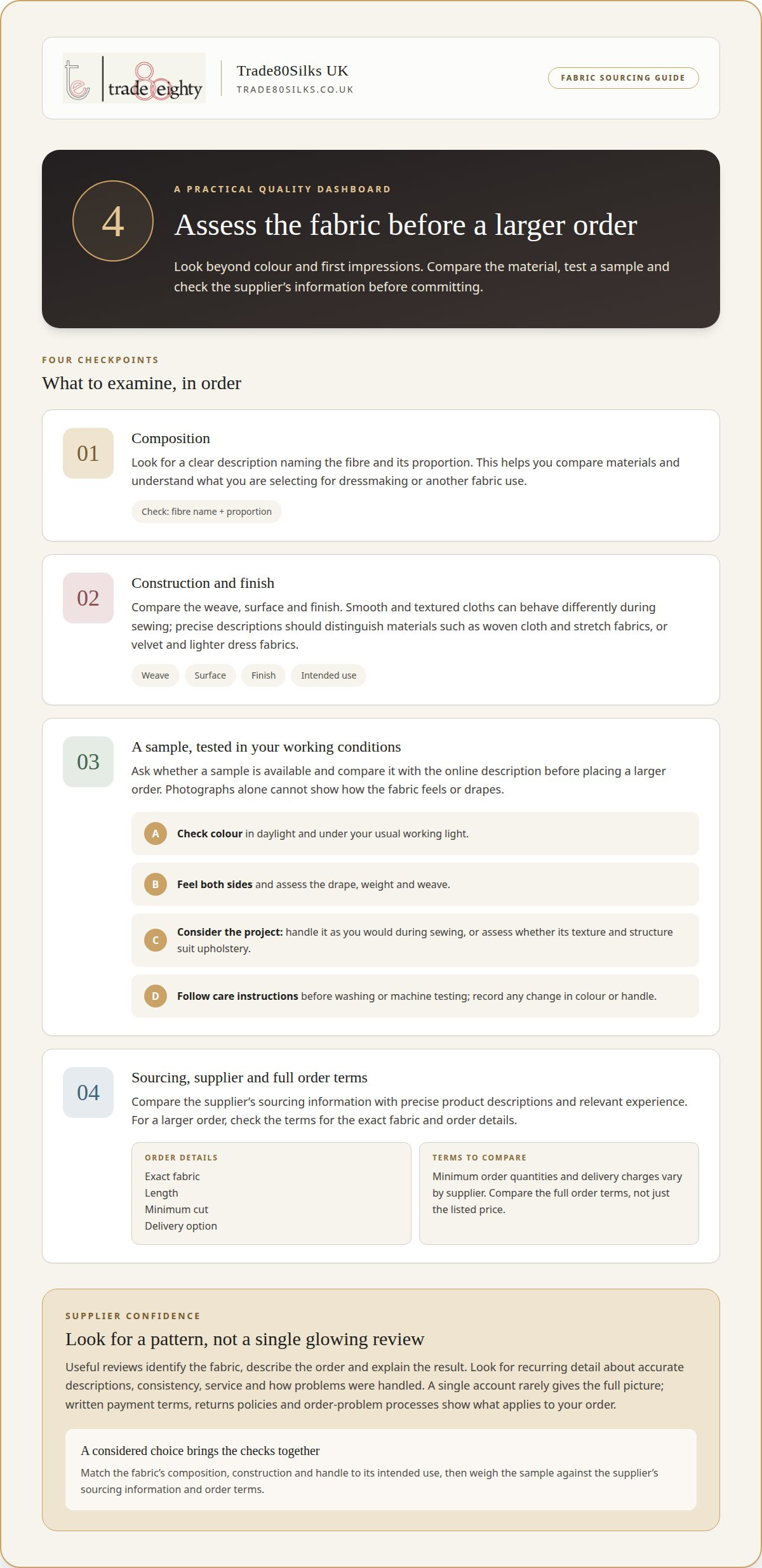
Fabric quality and sourcing
Quality involves more than colour: composition, construction and intended use all affect a fabric’s performance. Compare these details and the supplier’s sourcing information before ordering.
Fabric quality and composition
For a UK purchase, look for a clear composition description that names the fibre and its proportion. This helps you compare materials and understand what you’re selecting for dressmaking. Review the weave, surface and finish as well: smooth and textured cloths behave differently during sewing. Choose descriptions that address the needs of your project, whether it involves dressmaking, upholstery or other fabric use. Clear information helps you assess material claims without assuming every fabric is suitable for every purpose.
Samples and quality assessment
Ask whether a supplier can provide a sample, then compare it with the online description before placing a larger order. Check the colour in daylight and under your usual working light, feel both sides, and assess the drape, weight and weave. For dressmaking, handle the sample as you would during sewing; for upholstery, consider whether its texture and structure suit the project. Follow the care instructions before washing or machine testing, and record any change in colour or handle.
Prices, minimum orders and delivery costs
Fabric prices depend on fibre, weave, finish and the quantity ordered; minimum order quantities and delivery charges vary by supplier. Compare the full order terms for the exact fabric, length, minimum cut and delivery option, rather than judging the listed price alone. A sample can help avoid choosing by photograph, whilst a written total makes separate delivery costs visible. These factors, rather than a single typical figure, determine what a UK order will cost.
Quality and reliability checks
Before ordering, compare the product description, sample and care guidance, and check that the supplier presents composition and sourcing information consistently. Possible issues include differences between screen and fabric colour, unclear fibre descriptions and variation between batches. Keep the listing and order details together so you can describe any mismatch precisely. Consider whether a specialist range fits your project, and look for evidence supporting any sourcing claims rather than relying on wording alone.
How can I verify a UK fabric supplier’s quality and reliability?
Use a repeatable check rather than relying on polished product photography. First, compare the fabric’s description with its composition, finish and intended use. For example, a crisp cloth should not be described only as “soft and flowing”. Check whether the stated width, care guidance and colour description remain consistent across the product page, order details and sample. Save those details with your order confirmation.
Next, assess the supplier’s communication before purchase. Ask a specific question about a fabric’s weight, handle or suitability for your project. A useful reply addresses the question directly instead of repeating general sales language. Compare the answer with the listing, then review the written information about payment, delivery, returns and order problems. Clear terms help set expectations.
Assess a sample practically. Lay it flat, inspect the selvedge and look for visible irregularities, then handle it in ways relevant to your project. For dressmaking, assess how it drapes and moves; for a structured design, consider how well it holds its shape. Compare the sample with the online image in natural and indoor light, as colour can look different across screens and settings.
Before making a larger purchase, check that the product information, sample and order terms agree. Keep the listing and written replies so you can describe any mismatch precisely. Reviews add context, especially when they identify a fabric or explain how a concern was resolved. A pattern of clear descriptions and practical responses is more informative than a single glowing comment.
For a design that needs a distinctive textile direction, a bespoke fabric commission offers a way to discuss the material’s intended role and creative requirements. Explore a bespoke fabric commission when an existing fabric does not suit the brief.
Trade80Silks UK: Bespoke Fabric Commissions
Trade80Silks UK offers Bespoke Fabric Commissions for designers and makers whose project calls for a considered textile direction beyond an existing selection. The service can support custom-woven fabrics, jacquards, embroideries and digital prints, giving creative briefs a route towards a more individual material.
For a ready-made option, the collection includes Crinkle Silk Satin (#167), Printed Silk Organza (PS PEG 5) and Printed Tulle (PS PET 3x). Each brings a distinct surface and character to a design, while a bespoke commission can be suited to a specific creative vision. Share the intended use, desired look and relevant design references to begin a focused discussion about your fabric requirements.
For a project that calls for a distinctive textile or one of these silk fabrics, contact Trade80Silks UK to discuss your requirements.
Give your next design a considered starting point
The right fabric can shape a project from its first sketch, influencing movement, texture and the atmosphere of the finished piece. Treat material selection as part of the creative process: consider what the design needs to express, then choose a textile that supports that intention. This is a useful principle when learning how to find reliable fabric suppliers in the UK.
Trade80Silks UK offers Crinkle Silk Satin (#167), Printed Silk Organza (PS PEG 5) and Printed Tulle (PS PET 3x), each bringing a distinct character to a design. These options can help inform a direction, while a bespoke fabric commission may suit a brief that calls for a more individual approach. Let your intended use and visual references guide the conversation.
Ready to shape your material brief? Discuss your fabric ideas with Trade80Silks UK, and take the next step towards a fabric choice that feels true to your work.
Frequently Asked Questions
Can I buy fabrics in bulk?
Yes, fabric suppliers may sell bulk quantities, particularly to designers and manufacturers ordering for production. Trade80Silks UK offers wholesale and retail fabric sales, including bulk orders. Minimum quantities and ordering arrangements vary, so consider your required length, whether you need one continuous cut, and how much fabric your project consumes. For repeat production, a consistent specification helps you plan purchasing across future orders.
Where can I find reputable fabric suppliers in the UK?
You can find UK suppliers through specialist fabric businesses and online shops, choosing according to the fibres and intended use you need. Trade80Silks UK supplies premium silk and natural fabrics to designers and manufacturers. For other projects, look for suppliers whose range and product descriptions match your brief, whether you need dressmaking cloth, quilting cotton or a particular textile finish.
What certifications should UK fabric suppliers have, such as OEKO-TEX or GOTS?
There is no single certification that every fabric supplier should hold; relevance depends on the material and the sourcing claim. If a listing mentions OEKO-TEX or GOTS, check which product or production stage the certificate covers and whether its details match the fabric being sold. A certification logo alone does not explain fibre composition, feel or suitability, so assess those separately for your project.
How can I check UK fabric supplier reviews, business details and trading history?
Compare reviews across platforms, prioritising accounts that describe a specific purchase or explain how a query was resolved. Check that the supplier’s trading name is consistent across its product pages, terms and order documents. For a registered company, Companies House records can help you compare public company details. For a sole trader, review the business identity and terms shown on its documents.
What payment terms, returns policies and buyer protections do UK fabric suppliers offer?
Payment terms, returns policies and complaint processes vary between suppliers. Read the written terms before ordering, especially the conditions for returning cut lengths or made-to-order fabric.


