

A promising fabric sample is only the start. The real test is whether a young business can source enough material at a workable cost and with consistent quality. Problems with fabric sourcing for startups often affect founders, independent designers and small manufacturers whose production needs are modest but whose materials still need to support a considered, cohesive collection.
Colour, handle and drape may come first, but minimum order quantities, changing availability and quality variation can determine whether a design is practical to produce and reorder. This guide covers how to assess your fabric budget, manageable order quantities, sample quality, supply continuity and the details that make supplier comparisons useful. You’ll have a clearer way to balance creative ambition with production needs and spot sourcing decisions that need closer attention before you commit.
Key Takeaways
- Plan for continuity before approving a fabric: sample availability doesn’t always guarantee the same material can be reordered for production.
- Match minimum order quantities to realistic demand, and account for the full fabric budget before settling on a design.
- Assess samples for how they perform, not just how they look and feel, so potential defects or changes are caught early.
- Compare suppliers using clear details on specifications, consistency, delivery and order terms to make sourcing decisions with greater confidence.
1. Fabric continuity and reordering production yardage
A sample shows a fabric’s appearance and handle, but not whether it will be available later. A print chosen for a collection may be impossible to reorder months later, or production may face a long wait for the fabric. Before finalising designs, establish whether the material can be reordered, in what form and on what timeline.
Estimate yardage from the production plan, not just the sample garment. Work out fabric per finished piece, multiply by planned units, then allow for pattern layout, cutting waste and flaws. A blouse sample, for example, won’t show total requirements until the size range and order quantities are set. Ordering without that plan can leave you short for production or with stock tying up cash.
Swatches help assess colour and surface, while lab dips show proposed dye colours on the chosen base cloth. Allow 7 days for lab dips and 14 days for strike-offs before bulk fabric production. Pre-production samples then let you review the actual fabric and construction together. Sample and production dye lots can differ in appearance, so approve the relevant colour reference before committing to yardage.
For UK orders, applicable requirements depend on the fabric’s composition, intended use, dyes and import circumstances. There is no single certification to assume for every material. Identify the requirements that apply to the specific fabric and its use before ordering.
Scale carefully. Ordering 5 to 10 metres of sample fabric can help test a design before buying a bulk roll, but confirm how that sample relates to production stock. Add a 28-day buffer to the sourcing calendar, and plan cutting layouts to use each length efficiently. Fabric comparison charts and order-tracking dashboards can help teams record approved specifications, quantities and reorder timing as a collection grows.
2. Finding fabrics that fit a startup’s budget and minimum order quantities
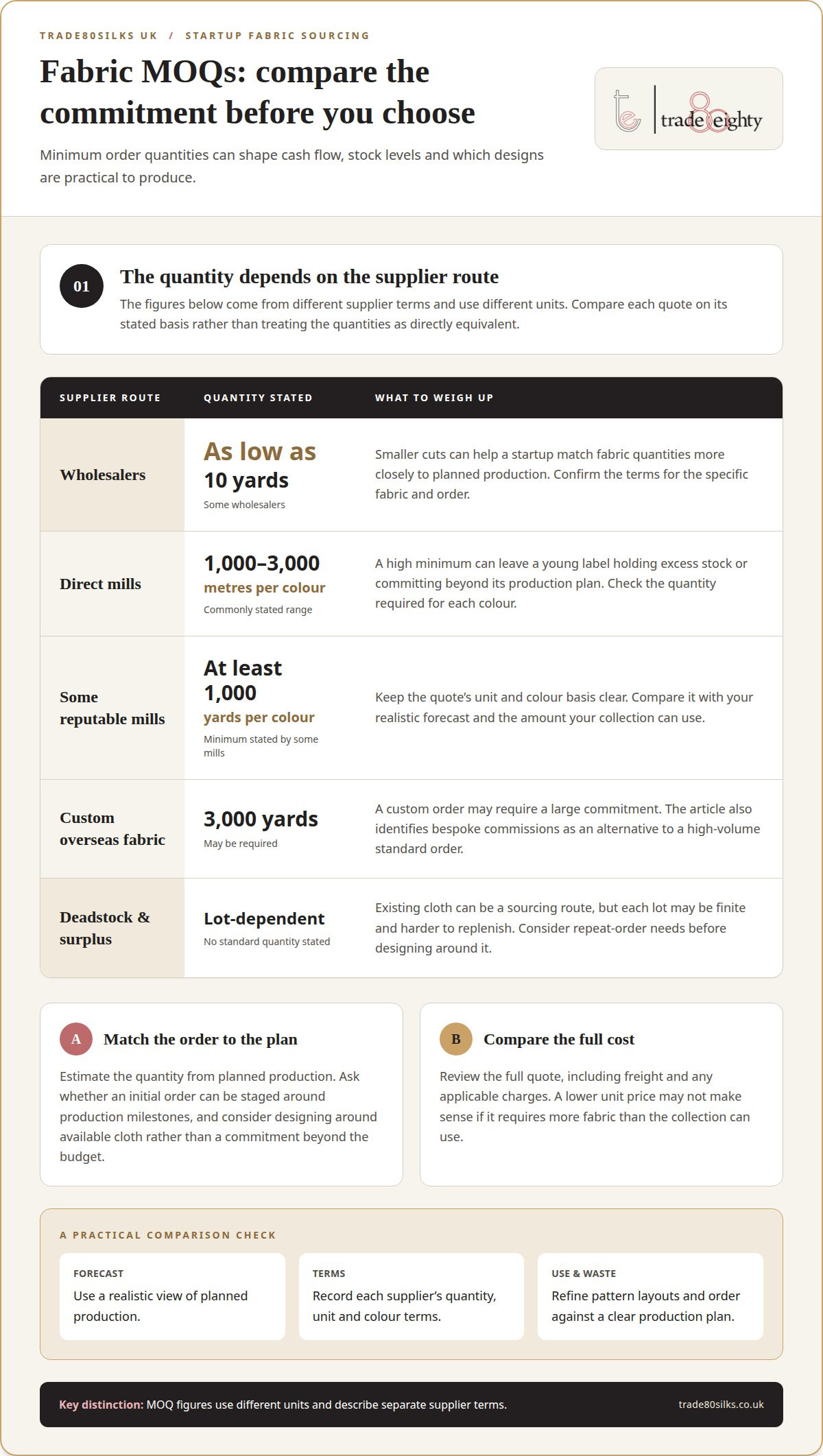
Fabric minimum order quantities (MOQs) shape cash flow and design choices. Some wholesalers offer quantities as small as 10 yards. Direct-mill MOQs commonly range from 1,000 to 3,000 metres per colour. Some reputable mills require at least 1,000 yards per colour, while custom overseas fabric may require 3000 yards. These different units reflect separate supplier terms, so compare each quote on its stated basis. High MOQs can leave a young label holding excess stock or facing a commitment beyond its production plan.
UK startups can approach fabric wholesalers for smaller cuts, with some offering quantities as low as 10 yards. Deadstock sellers and surplus-stock channels are another route, although each lot may be finite and harder to replenish. Match the quantity to planned production, then consider designing around available cloth rather than commissioning a fabric that exceeds the budget.
To negotiate payment terms and control sourcing costs, share a realistic forecast and ask whether an initial order can be staged around production milestones. Compare the full quote, including freight and any applicable charges, then reduce waste by refining pattern layouts and ordering only against a clear production plan. A lower unit price may not make sense if it requires more fabric than the collection can use.
Sustainable options include deadstock and fabrics made with recycled or organically produced fibres. Ask for clear information about composition and sourcing, as sustainability claims depend on the material and how it is produced. Deadstock makes use of existing cloth, but limited quantities can make repeat orders difficult.
For a distinctive material developed around a project’s needs, bespoke fabric commissions can be a considered alternative to a high-volume standard order.
3. Fabric quality inconsistencies and defects
A swatch may look even while the production fabric varies. Inspect the full width for shade bands, weave irregularities, pulls, holes and differences in finish. With printed fabric, compare motif scale and alignment; with plain weave, check yarn consistency and surface texture. Variations can affect cutting, garment appearance and usable yardage. Record issues against the roll and fabric specification instead of relying on memory.
Test performance before approving production. A 100% cotton jersey can shrink by 10% or more in its first wash, so measure a sample before and after laundering. Record the method and results, then consider whether the change affects pattern dimensions or fit. Check colourfastness and surface behaviour using the care process intended for the finished item. A sample that changes markedly after washing may need a different handling plan.
Inspect production rolls promptly on arrival. A vendor may refuse action after 45 days, so keep the delivery date and inspection record together. Unroll fabric under consistent lighting, note visible defects and photograph the affected areas beside a clear scale. Mark defect positions and lengths, then separate unusable sections before cutting. This creates a practical record of what was received and helps identify whether issues recur across multiple rolls.
Compare production fabric with the approved sample, not just its written description. Check colour, weight, handle, width and finish side by side, and note differences before cutting. If a roll varies, pause work on affected sections and assess the usable yardage. Cutting first can carry defects into finished pieces. Keep the approved sample, specification and inspection notes together for future orders, so you can identify changes rather than mistake them for normal variation.
4. Supplier evaluation and sourcing checklists
A sourcing checklist helps you compare suppliers on more than price. Depending on one fabric supplier can leave a collection exposed to stock interruptions, delivery delays or changes in quality. A second source may reduce that risk, but composition, colour and finish still need careful comparison. Record each supplier’s specifications and terms against the same requirements before ordering.
Request swatches from several suppliers and assess them against the intended garment and production needs. Ask for fabric specifications, GSM and fibre composition, as well as relevant performance details such as shrinkage, pilling and breathability. For a customised design, mockups and pre-production samples can show how the proposed fabric will translate into the finished material.
- Specification: Record composition, GSM, width, weave and finish for each candidate.
- Performance: Compare shrinkage, pilling and breathability; consider custom laboratory testing where useful.
- Delivery: Note estimated delivery time and whether the fabric is made-to-order or ready-to-ship.
- Order visibility: Establish how order tracking and real-time updates are provided.
- Full quote: Confirm whether quoted prices include taxes, duties and freight.
- Custom work: For printed or developed designs, include mockup and pre-production sampling support in the assessment.
Test samples through five industrial wash cycles, recording changes in colour, handle, dimensions and surface. This gives the team a consistent basis for comparing candidates, rather than relying on a first-touch impression. Keep the results with each supplier’s specification so later decisions use the same evidence.
A single-source strategy may work for a small initial run, but it concentrates continuity risk. Where practical, document an alternative fabric or supplier and note differences that could affect the design. A concise, shared checklist helps a startup make that choice deliberately and keep a record of the reasoning.
For a project that needs a considered custom material, discuss a bespoke fabric commission as part of your sourcing assessment.
Trade80Silks UK: Bespoke Fabric Commissions
Trade80Silks UK offers Bespoke Fabric Commissions for designers and manufacturers whose concepts call for a carefully considered textile. This can be a natural next step when standard fabric choices do not suit a project’s desired surface, print or material character, and the brief needs to guide the commission.
For ready fabric options, Crinkle Silk Satin ( #167 ), Printed Silk Organza ( PS PEG 5 ) and Printed Tulle ( PS PET 3x ) offer distinct textures and visual qualities for creative work. The right choice depends on the design’s intended look and how the fabric will be used. A clear brief describing the desired appearance and application gives the commission a practical creative starting point.
To discuss a fabric requirement or bespoke commission, contact Trade80Silks UK.
Shape the next sourcing decision around your design
A sourcing plan works best when it starts with the piece you want to create, rather than forcing the design into an unsuitable material. For founders facing problems with fabric sourcing for startups, begin by defining the qualities that matter most: drape, surface, colour and intended use. A focused brief turns those creative priorities into a clearer material direction.
Consider whether an existing fabric can serve the design, or whether a bespoke commission better suits its character. Trade80Silks UK offers a considered selection of silk fabrics alongside bespoke commissions, giving designers and makers a route to explore material choices in relation to their work.
Bring your sourcing requirements and creative direction together in a conversation. Contact Trade80Silks UK to discuss sourcing, and take your next design decision forward with care and clarity.
Frequently Asked Questions
Who faces these sourcing problems?
Independent designers, new fashion labels and small manufacturers often face tight constraints: their first collections need distinctive materials, but they lack the purchasing scale of established brands. A designer making a limited run, for example, may find that a mill’s minimum order per colour exceeds planned demand. Costume and couture businesses can also face continuity concerns when a particular textile is central to a design.
What are the biggest fabric sourcing challenges for fashion startups?
The main problems with fabric sourcing for startups are matching availability, order quantities and quality to a young brand’s production plan. A sample may suit the design but be unavailable in sufficient quantity, while a large order can tie up the budget in unused stock. Startups also need to consider material performance, production timing and whether a later batch will match the original.
What minimum order quantities do UK fabric suppliers require?
UK fabric suppliers do not share one universal minimum order. Wholesalers may sell smaller cuts, while mills often set larger minimums per colour, and custom production can require a bigger commitment. Ask whether the quantity applies per fabric, colour or design, and whether it is measured in metres or yards. These details help you compare offers with your planned output.
How much do fabrics cost for small fashion brands in the UK?
There is no standard price that works for every small fashion brand. Fabric costs depend on fibre, construction, finish, order quantity and supplier terms. Estimate the project by multiplying the quoted unit price by the required length, then allowing for sampling, cutting waste and delivery charges. Compare quotes for equivalent specifications rather than choosing only by the lowest figure.
How can startups check fabric quality, colour consistency and shrinkage before ordering?
To address problems with fabric sourcing for startups, keep a labelled reference swatch and compare production material beside it under consistent lighting. To assess shrinkage, mark and measure a sample, wash it according to the intended care process, then measure it again after drying. Keep an untreated control swatch for comparison. Record changes in colour, dimensions and surface so the design team can judge their effect on the finished garment.
How do lead times and shipping costs affect fabric sourcing for startups?
Long lead times can delay sampling, production and launch dates, while shipping adds to the total amount committed to materials. Shipping costs may account for 15% to 20% of a startup’s total fabric budget. Include delivery in the project estimate and work backwards from the intended production date, allowing time for samples, approvals and transport rather than scheduling only around sewing.


