

A polished surface does not guarantee that fabric will perform well. Knowing how to test fabric quality before buying means looking beyond colour and first impressions to assess the weave, feel, recovery and signs of wear that matter for your intended use.
It is reasonable to want fabric that retains its character through handling and use, especially when photographs cannot show its full texture or weight. A few simple checks can help: inspect the surface and edges, gently stretch and release the fabric if it has give, and press a damp white cloth against a discreet sample to check for colour transfer.
This guide explains how to assess colour transfer, durability, stretch recovery and visible clues to breathability, while accounting for how different fibres and finishes behave. It also explains why drape, sheen and weight should be judged in context, helping you choose fabric with greater confidence for your project.
Key Takeaways
- Judge a fabric by its fibre, construction and intended use, rather than relying on sheen or price alone.
- Use a careful colour-transfer check to spot potential bleeding, while allowing for intentional variation in artisan-made textiles.
- Assess durability through resistance to abrasion, shape recovery and signs of weakness at stress points.
- Use GSM and a light-source inspection as initial clues to weight, density and breathability, not as proof on their own.
How do I check if a fabric will bleed colour?
Use daylight, close inspection and appropriate colour-fastness tests to assess colour before choosing fabric. Distinguish genuine flaws from intentional variation, particularly in natural and artisan-made cloth.
-
Inspect colour and print in daylight
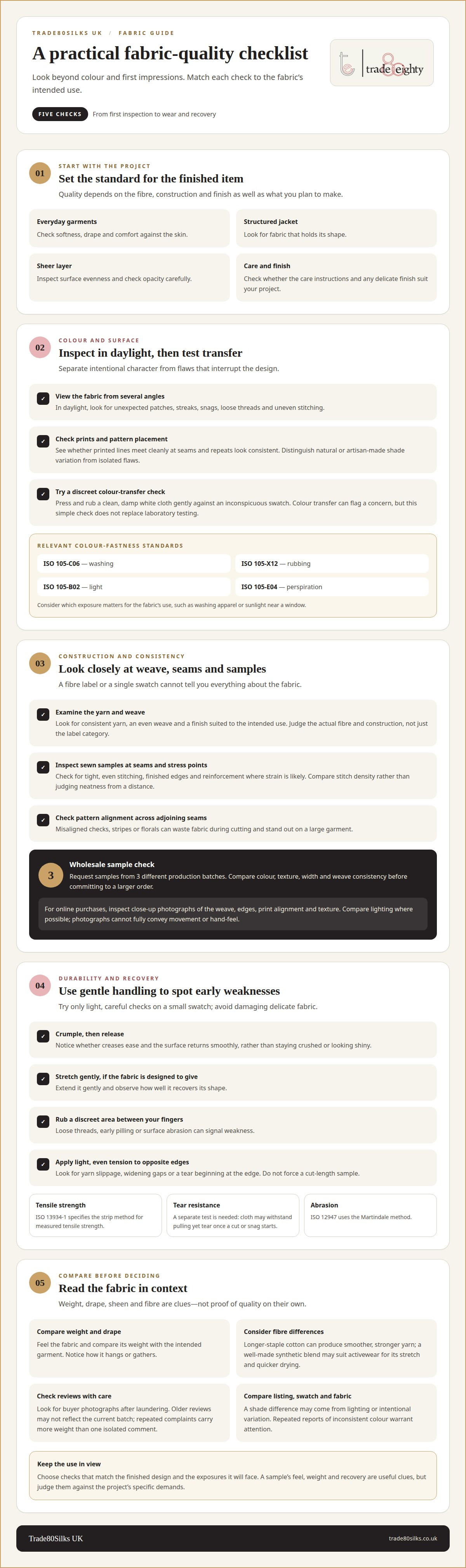
Hold the fabric in daylight and examine its surface from several angles. Look for unexpected patches, streaks, snags, loose threads and uneven stitching. Check whether printed lines meet cleanly at seams or repeat consistently. A cotton floral print, for example, should show intentional placement rather than accidental breaks. Natural or artisan-made textiles can vary in shade, so distinguish characteristic variation from isolated flaws that disrupt the design.
-
Check colour fastness
Test an inconspicuous swatch with a clean, damp white cloth, pressing and rubbing gently to see whether colour transfers. This simple check can flag a concern, but it doesn’t replace laboratory testing. According to the International Organization for Standardization, ISO 105-C06 is a standard for testing the colour fastness of textiles to washing. ISO 105-X12 covers rubbing, ISO 105-B02 light, and ISO 105-E04 perspiration. Consider which exposure matters for the fabric’s use, such as washing apparel or sunlight near a window.
- When shopping online, inspect product photographs closely. Look for clear images showing the weave, colour, edges, print alignment and surface texture, as distant shots can conceal flaws. A fabric shown hanging or gathered offers clues to its drape, but photographs cannot fully convey movement or hand-feel. Compare images taken in different lighting, since light can make a finish look brighter or duller.
- Where possible, compare the listing, swatch and fabric together. A difference in shade may reflect lighting or intentional variation, while repeated complaints about inconsistent colour warrant attention. For UK purchases, distinguish a change-of-mind return from a concern about faulty fabric or a mismatch with its description. Cut-to-length fabric may have different return conditions, so read the seller’s terms before ordering and keep the product description if an issue arises.
How can I tell if a fabric is good quality?
Knowing how to test fabric quality before buying starts with matching fibre, construction and finish to the intended use. Natural and synthetic fabrics have different qualities; neither is automatically better, as comfort and durability depend on the material and how it is made.
-
Tailor quality checks to the fabric’s use
Match each check to the finished item. For everyday garments, assess softness, drape and comfort against the skin. A structured jacket needs fabric that holds its shape, while a sheer layer calls for an even surface and careful opacity checks. Consider care instructions, too: a delicate finish or chemical treatment may require gentler handling than your project allows.
-
Check whether samples represent production
Compare a swatch with the production fabric before committing to a larger order. For wholesale sourcing, request samples from 3 different production batches, then compare colour, texture, width and weave consistency. A sample alone may not reveal variation between batches. Read recent reviews and look for buyer photographs showing the fabric after laundering; a review from eight months earlier may not reflect the current batch. Repeated complaints carry more weight than one isolated comment.
-
Inspect stitching and pattern alignment
Examine a sewn sample at the seams and stress points. Look for tight, even stitching, finished edges and reinforcement where strain is likely. Compare stitch density rather than judging neatness from a distance. For checks, stripes or florals, see whether the pattern aligns across adjoining seams. Misalignment can waste fabric during cutting and stand out on a large garment.
-
Compare natural and synthetic fabric quality
Assess the actual fibre and construction, not just the label category. Longer-staple cotton can produce smoother, stronger yarn, while a well-made synthetic blend may suit activewear because of its stretch and quicker drying. Check for consistent yarn, an even weave and a finish suited to the intended use. A fibre label alone does not prove quality, so evaluate the textile in relation to the finished design.
A useful way to approach how to test fabric quality before buying is to assess a sample against the garment’s specific demands. For a project with precise material requirements, refine the fabric brief around its intended use, handle and finish.
Durability tests for tensile strength, tear resistance and stretch recovery
Before buying, feel the fabric, compare its weight with the intended garment and observe how it drapes. A sample’s softness, substantial yet supple feel, and recovery after gentle crumpling offer useful clues to its suitability.
-
Crush, stretch and rub the fabric
Take a small swatch and gently crumple it in your hand, then release it. Notice whether the creases ease and the surface returns smoothly, rather than remaining crushed or looking shiny. If the textile is designed to stretch, extend it gently and observe its recovery. Rub a discreet area between your fingers; loose threads, early pilling or surface abrasion can signal weakness. Avoid pulling hard, as this can damage delicate patterns before purchase.
-
Check tensile strength and tear resistance
Hold opposite edges of a sample and apply light, even tension. Look for yarn slippage, widening gaps or a tear beginning at the edge, but don’t force a cut-length sample. For measured tensile strength, ISO 13934-1 specifies the strip method. Tear resistance requires its own test, since a cloth may withstand pulling yet tear once a cut or snag starts. For abrasion, ISO 12947 uses the Martindale method; 15,000-20,000 rubs is listed for light domestic fabric use.
-
Check stretch recovery and dimensional stability
Measure a marked section before and after gentle stretching, then compare its length once released. A lasting distortion can affect fit, hems and patterns in clothing. Washing can affect a fabric’s dimensions, so check for changes after laundering. Check the care instructions and test a swatch using the intended washing method. Dimensional stability limits depend on use; less than 3% is a usual limit for apparel exports.
How do I check fabric breathability visually?
Use light, surface density and GSM as clues to fabric weight and likely airflow. These visual checks help compare samples, but cannot confirm breathability on their own.
- Check the supplier’s GSM, which means grams per square metre, then compare it with the fabric’s purpose. For casual garments and T-shirts, 140-180 GSM is lightweight, 180-220 GSM suits everyday wear, and 220+ GSM is described as more premium. Higher GSM generally means greater weight, density and opacity, not automatically better comfort or airflow.
- Estimate GSM if you have a sample, a scale and a clear cutting square. Cut a 10 cm × 10 cm swatch, weigh it in grams, then multiply that figure by 100. For example, a sample weighing about 0.9 g is approximately 90 GSM. Compare the result with the stated composition and intended use, rather than treating weight alone as proof of strength.
- Hold the textile against a light source and check how evenly light passes through. Uneven density, obvious holes or gaps can reveal differences in construction, while opacity offers a clue to how closely the yarns sit together. Compare similar fabrics under the same light. Sheer and opaque weaves serve different purposes and should not be judged by identical expectations.
- For knitted fabric, look at the loops and ask about the knit gauge. A higher gauge indicates a finer, denser and smoother knit, which can affect the surface feel and airflow. Treat this as a visual clue, not a complete airflow test. Fibre, yarn, structure and finish all influence the result.
For a project with precise weight and density needs, develop a bespoke fabric brief around its intended use.
Trade80Silks UK: Bespoke Fabric Commissions
Trade80Silks UK offers Bespoke Fabric Commissions for designers and manufacturers whose projects call for a considered fabric specification. This is a natural next step when standard cloth doesn’t align with your intended drape, texture, pattern or finish. A clear brief can set out how the fabric will be used and the qualities that matter most, helping shape a commission around the project.
For a point of reference, the selection includes Crinkle Silk Satin ( #167 ), Printed Silk Organza ( PS PEG 5 ) and Printed Tulle ( PS PET 3x ). These distinct materials offer different surfaces and structures to consider alongside your design requirements.
To discuss a fabric direction for your project, contact Trade80Silks UK.
Make your fabric choice serve the design
Let the intended project set the standard for your final fabric choice. A cloth need not excel in every quality; it needs to suit how it will be cut, handled and worn or displayed. A considered approach to how to test fabric quality before buying turns observations into a practical brief: describe the desired hand, movement, colour character and care requirements, then rank what matters most. This keeps material selection connected to the design, rather than appearance alone.
This distinction matters especially when a design depends on a particular balance of softness, structure and movement. Write down the priority in plain terms and keep it beside your sketches or production notes. It provides a consistent reference for later decisions without limiting the artistry of the finished work.
When you’re ready to discuss a fabric direction for your project, contact Trade80Silks UK. A clear brief is a thoughtful beginning for your next creative decision.
Frequently Asked Questions
Is some shrinkage normal for cotton?
Yes, cotton can shrink, particularly during its first wash, although the amount depends on its construction and finish. Check the care instructions before laundering, since heat and agitation can affect dimensions. If the finished fit is critical, allow for possible changes during planning and test a spare piece using the intended care method before cutting the main fabric.
How do you test fabric for colourfastness without damaging it?
Use a discreet area or spare swatch rather than testing the visible face of a finished piece. Lightly press a clean, damp white cloth against the fabric, then inspect it for transferred dye. Avoid vigorous rubbing, which can abrade delicate surfaces. For a garment that will be washed, assess a separate sample under the intended care conditions.
How can you check fabric for pilling, snags and loose threads in a shop?
Examine the cloth under bright lighting, then turn it slightly to catch raised fibres and surface irregularities. Run your fingertips gently across a sample in both directions, feeling for bobbles or catches without pulling them. Check folds and cut edges for loose threads, and look for pills where the fabric has rubbed against itself.
How do you identify fabric fibre content and verify the label is accurate?
Start with the composition on the product label, but do not rely on touch or appearance alone to identify a fibre. Blends can be difficult to distinguish by eye, especially when yarns or finishes alter the surface. For a dependable assessment, have a sample examined by a textile testing laboratory. Do not burn fabric at home, as this damages the sample.
How can you test whether fabric will shrink or stretch after washing?
Set aside a sample and mark a measured section before washing it according to the fabric’s care instructions. Once dry, compare the marks and note any change in shape or length. For stretch fabrics, also observe whether the material returns to its original form after laundering. Keep the results with your project notes to guide cutting and fit decisions.
What do GSM and thread count indicate about fabric quality?
GSM helps compare fabric weight, while thread count is commonly used to assess bed linen. Neither figure proves quality by itself: fibre, weave, finishing and intended use all affect how cloth performs. Compare like with like and consider whether the fabric feels and behaves appropriately for the project. A dense, heavy textile is not automatically the best choice for every design.


