

A larger fabric minimum does not automatically dictate how many garments an order will produce. Understanding fabric minimum order quantity starts with separating a fabric MOQ, usually measured in metres or yards, from a clothing factory’s minimum for finished pieces. Garment yield depends on the fabric used per piece, including cutting waste.
When planning a collection, it is natural to focus on styles and garment quantities, but supplier minimums can shape those decisions too. Stock cloth and made-to-order fabric may have different requirements, while fabric width, print and pattern layout affect how much material each garment needs.
This guide explains what MOQ means in clothing manufacture, how fabric minimums translate into garment quantities and why mills and factories set their own thresholds. Understanding how those requirements interact helps you plan the cloth, styles and production volume more clearly.
Key Takeaways
- Separate the fabric minimum from the factory’s finished-garment minimum when planning an order.
- Estimate garment output by considering cloth use per piece, cutting waste and the fabric’s width and pattern.
- Understand how stock materials, custom production and supplier batch requirements can shape your order.
- Recognise how setup and production costs influence minimums, and what that means for smaller runs.
What Defines Minimum Order Quantity (MOQ) in Textiles?
In clothing production, a minimum order quantity is the smallest amount a supplier or factory accepts for a particular fabric or garment order. Fabric and finished clothing can have separate minimums, so a fabric threshold does not directly determine the number of garments produced.
Minimums by fabric and production type
A fabric MOQ sets the minimum cloth purchase, whilst a garment MOQ sets the minimum number of finished pieces. Requirements vary with fabric, customisation, product type and production setup. Clothing factories may set minimum orders from 50 units to thousands of units, depending on the production work involved.
There is no single typical fabric MOQ for UK suppliers: stock cloth can be bought close to the length needed, while made-to-order cloth carries the mill’s production minimum. AEM Textile recommends beginning a first collection with 3-5 core fabrics, which offers range-planning guidance rather than a universal supplier threshold. Using one cloth across several styles can also let those styles draw on one fabric minimum. A workshop may cut a brand’s required metres from a larger piece shared across orders.
A supplier may offer quantities below its stated minimum as short cuts, sometimes with a surcharge per metre. Samples are a separate matter from production fabric, so distinguish sample terms from the MOQ for a production cut.
Measuring fabric minimums
Fabric minimums may be measured in metres or yards, or set by roll or weight. The unit matters: a roll or weight requirement must be translated into usable cloth for the planned designs. A garment factory’s minimum, by contrast, is counted in finished pieces and may be divided by style, colour or size.
Ask for a quote that clarifies the unit, quantity and whether the minimum applies per colour. It should also explain how VAT, delivery and lead times are handled, so you can understand the order commitment and expected timing.
MOQ effects on fabric and order costs
A fabric minimum affects the total order cost because it sets how much cloth you must purchase, even if the project needs less. A larger order may lower the price per metre, but it increases the upfront outlay and can leave unused material or unsold stock.
Before committing, compare the minimum with the project’s expected fabric use and planned styles. Any surplus may need storage or remain without a clear role in a future collection.
How fabric minimums translate into garment quantities
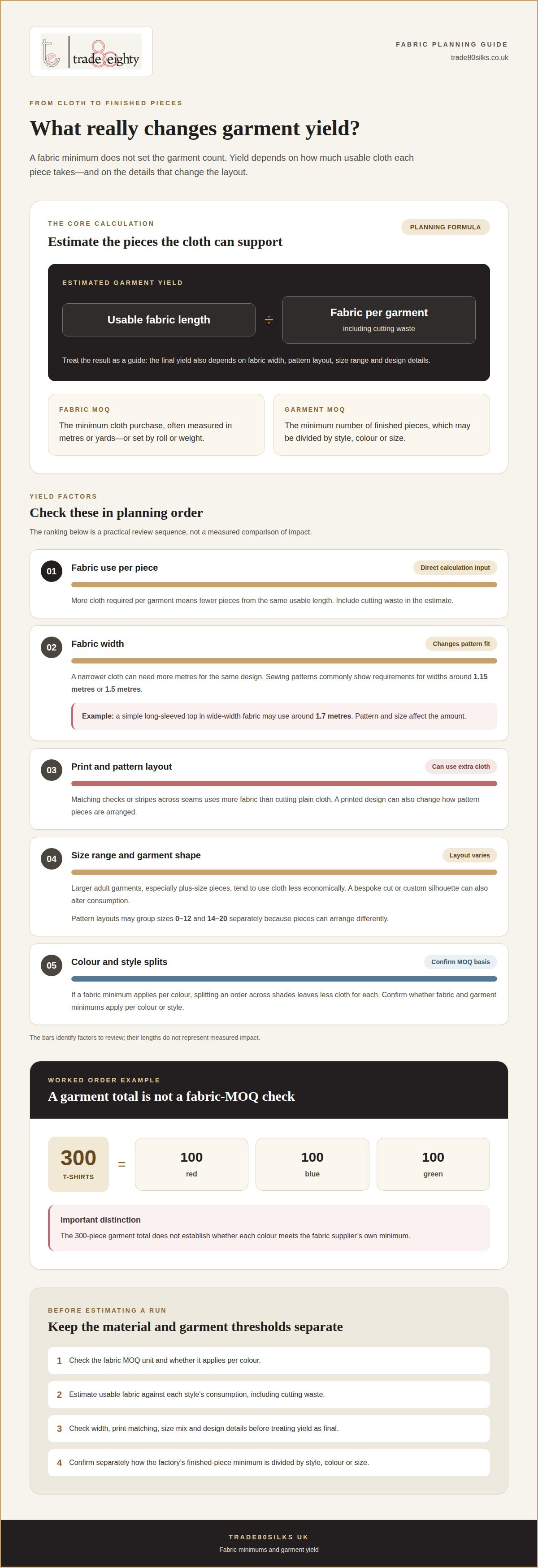
Estimate garment yield by dividing the usable fabric length by the amount each piece requires, including cutting waste. The more fabric each garment uses, the fewer pieces the same minimum will yield. Treat this as a planning guide: final yield depends on pattern layout, fabric width, size range and design details.
Width changes how pattern pieces fit across the cloth. A narrower fabric can require more metres for the same clothing design, reducing garment yield. Sewing patterns commonly show requirements for widths around 1.15 metres or 1.5 metres. A simple long-sleeved top made with wide-width fabric may use around 1.7 metres, though its pattern and size affect the amount.
Print and colour choices also affect the calculation. Matching checks or stripes across seams uses more cloth than cutting plain fabric, while a printed design can change the pattern layout. If the minimum applies per colour, splitting an order across shades leaves less fabric for each. Confirm whether the supplier’s fabric threshold and the factory’s garment threshold apply per colour or style.
Size distribution matters, too. Larger adult garments, especially plus-size pieces, tend to use cloth less economically. Pattern layouts may group sizes 0-12 and 14-20 separately, because each range can arrange pattern pieces differently. A bespoke cut or custom silhouette may also alter consumption, so one estimate should not be applied unchanged across every style.
Consider a factory with a 300-piece style minimum: an order could comprise 100 red, 100 blue and 100 green T-shirts. That garment total doesn’t establish whether each colour meets the fabric supplier’s own minimum. A small layout experiment can reveal how print matching, size mix and cutting waste affect the yield. For custom printed concepts, bespoke fabric commissions can be relevant to the material plan.
How fabric suppliers’ minimums affect apparel MOQs
A clothing factory’s garment minimum may reflect the fabric it needs to purchase, as well as trims and production setup. When planning a new concept, consider supplier and factory thresholds together.
Supplier minimums and apparel orders
A fabric supplier’s minimum sets the quantity a factory must source before making an apparel order. The factory may need to buy fabric and trims for a production run because it cannot hold every option in stock, and each supplier may have its own minimum.
Stock fabrics and common colours can have lower requirements than custom-dyed or woven materials, while printed fabrics may carry higher minimums. Material may be sold by the roll in quantities sufficient for hundreds or even thousands of outfits. The fabric threshold can therefore exceed the clothing quantity a brand intended to order.
Factors affecting fabric and garment minimums
Fabric type, colour, print and production method influence fabric minimums; garment complexity and factory setup influence finished-piece minimums. Custom-woven labels, special buttons and branded zips can introduce further batch requirements, even when the fabric quantity suits the design.
Fabric weight also shapes how a garment falls: lighter fabrics are usually drapier, while heavier cloth often lends more structure. A factory specialising in a product such as T-shirts may fit an order into its production more easily. That can create flexibility in garment quantities, but it does not remove a mill’s fabric minimum.
Negotiating or reducing supplier minimums
To discuss a lower fabric MOQ, ask why the supplier sets it at that level and discuss the production constraints behind it. A buyer might offer a higher price per unit for a smaller order, propose a trial order for a new product or provide a long-term forecast to demonstrate commitment.
These approaches can help align an initial purchase with a concept while building towards an ongoing order. They do not change underlying factors such as batch setup or custom production. If the required fabric is already in stock, choosing it instead of commissioning a custom dye or weave may also make a smaller order more workable.
Meaning and purpose of minimum order quantity
A minimum order quantity is a production threshold that makes a textile or clothing order workable for the supplier. It reflects the resources needed to prepare materials and manufacturing, not simply the number of finished pieces a brand wants.
For a mill, weaving, dyeing and finishing involve batch setup that changes little with the length produced. A short run spreads that setup work across less cloth, while a larger batch spreads it further. In clothing manufacture, preparing patterns, changing machinery and organising staff also take time, whether the factory makes a small or large order.
This explains why an MOQ can support production flow as well as cost recovery. Spreading fixed setup and labour expenses across more finished garments can reduce the cost per unit. A small order may also leave a factory storing surplus raw materials, adding to its expenses. The threshold reflects these practical pressures, but does not by itself show whether a range suits a brand’s demand.
A useful way to understand a minimum is to connect it to the work it enables. A tech pack describes the garment and its materials; its fabric, pattern and construction choices affect sourcing and production preparation. A simple T-shirt may require less complex preparation than a garment with trims or embellishments, so their production requirements can differ. Textile minimums can apply to raw fabric procurement, while garment minimums apply to finished clothing.
The trade-off is between the efficiency of a larger run and the risk of holding more stock than the project can use. Before settling a quantity, map the fabric threshold against planned styles, colour choices and expected sales. That gives the MOQ meaning beyond a supplier’s minimum: it becomes a production constraint to plan around, not a demand forecast. For a distinct material concept, discuss a bespoke fabric commission as part of aligning the cloth with the intended production.
Trade80Silks UK: Bespoke Fabric Commissions
Trade80Silks UK can help designers and manufacturers shape a material choice around a considered apparel concept through Bespoke Fabric Commissions. This is a natural next step when standard fabric options don’t match the intended texture, print or visual character, and the fabric brief needs to align with the planned garment order.
For projects exploring established materials, the selection includes Crinkle Silk Satin ( #167 ), Printed Silk Organza ( PS PEG 5 ) and Printed Tulle ( PS PET 3x ). Each offers a different starting point for considering how a textile’s surface and drape may support a design. For a more individual direction, a bespoke commission can bring custom fabric development into the conversation alongside the garment’s intended use and production plan.
Share the material direction and apparel concept with Trade80Silks UK to discuss a Bespoke Fabric Commission.
Shape your next fabric decision
Understanding fabric minimum order quantity is most valuable when it helps shape a collection, rather than being treated as an isolated production figure. Before committing to a concept, consider its intended character, use and design priorities together. This gives material choices a clear creative purpose and keeps the next decisions connected.
A considered fabric brief can describe the desired texture, surface, colour story and role within the garment range. These qualities help focus discussion on whether an existing textile or a more individual approach best supports the design. The aim is not simply to meet a threshold, but to choose cloth that fits the finished vision.
When you’re ready to explore that direction, contact Trade80Silks UK to discuss your fabric needs. A well-shaped material concept is a thoughtful beginning, and the right fabric can give your collection its own distinctive expression.
Frequently Asked Questions
What does MOQ mean when manufacturing clothing?
An MOQ means the minimum number of finished garments a manufacturer accepts for an order or style. It sets the production commitment, not necessarily the quantity required in every size. For example, one style order can be allocated across sizes and colours, subject to the factory’s terms. Treat the MOQ as a starting point for planning the order breakdown.
What affects a factory’s MOQ?
A factory’s MOQ depends on the preparation and production work a garment requires. Pattern development, grading, machinery changes, specialist trims and staff time can all affect the threshold. A factory focused on one garment type may organise that work more efficiently than one handling varied products. A straightforward design with standard components may therefore fit the production schedule differently from a highly detailed piece.
What is a fabric minimum?
A fabric minimum is the smallest quantity of a particular cloth a supplier will sell or produce in one order. It may apply to a specific colour or custom specification, so a fabric quote should distinguish the material requirement from the finished-garment quantity. For a designer developing a range, this helps show whether the cloth can serve several planned pieces or is specific to one design.
What is the difference between stock and made-to-order cloth?
Stock cloth is already available, so a buyer may purchase a length closer to the project’s needs. Made-to-order cloth is produced for the order and carries the mill’s production minimum. This distinction matters when a design calls for a particular colour, weave or finish: available stock can keep material purchasing aligned with a smaller project, while a custom specification involves commissioning production.
Why establish MOQs with manufacturers?
Agreeing the MOQ before committing to a clothing range helps brands align planned styles, purchasing and production volume. It clarifies the scale a manufacturer can schedule and gives the design team a boundary for developing the collection. For a new label, this can inform which pieces belong in the first release and which are better reserved for a later range or reorder.
Why do factories have MOQ requirements?
Factories set MOQs because production preparation takes work that does not shrink in proportion to order size. Staff may need to grade patterns, change machinery and organise a production line, while a small job can leave surplus raw materials to store. A minimum helps make those commitments workable across the finished order and keeps production planning coherent.


