

A beautiful fabric can still be the wrong choice for couture if its minimum order, performance or repeat availability conflicts with the design. Material sourcing for couture designers means balancing a fabric’s character with its suitability for the garment and the realities of production. Supplier minimums vary: some suppliers set orders of a few hundred yards, while mills may require a thousand yards or more.
A fabric’s weight, drape, finish and hand feel shape how a design comes to life. The right choice must also suit the collection’s quantities and timeline. This guide explains how to assess suppliers, compare textiles, plan minimum orders and weigh creative intent against quality, cost and continuity.
From the initial brief to sample evaluation and production planning, each decision can protect the design’s integrity and keep sourcing aligned with the work ahead.
Key Takeaways
- Assess a sourcing partner against a precise material brief, including fibre, finish, intended use, quantity and delivery timing.
- Compare textiles by how they perform and feel, as well as by provenance, care needs, durability and supply-chain transparency.
- Plan orders around usable yield, potential defects and minimum quantities to balance design intent with cash flow and waste.
- For specialist fabrics, consider stock-supported materials, smaller mills or limited-edition approaches, then match the choice to your collection’s need for continuity.
How a professional evaluates suppliers and builds sourcing partnerships for couture
A sourcing partner starts with a focused brief that links the design to production. Specify fibre content, weight, hand feel, colour range, finish, intended garment, target price, minimum quantity and delivery deadline. Sharing the brief ahead of a supplier meeting gives both parties time to prepare relevant swatches and technical details. For a silk evening piece, for example, you might prioritise fluid drape, a particular finish and a defined colour range.
The partner then assesses whether the supplier can meet those requirements consistently, rather than relying on an appealing sample alone. They request technical sheets, fibre composition details, testing information and relevant certifications, then compare the sample against the documented specification. Ask where the fibres are produced and where the fabric is spun, woven or knitted, dyed and finished. Also clarify how the supplier manages differences between the sample and production. Assess certifications by their scope, relevance to the exact material and current validity.
Counterfeit, restricted or endangered-animal materials can create risks of misrepresentation, poor traceability and reputational damage for a couture house. A sourcing partner helps manage these risks by tracing material origins and reviewing supporting documentation, rather than relying on a supplier’s broad description.
Plan delivery by mapping supplier lead times against sampling, approval and production milestones. Consider the required quantity, availability and deadline together, then build the material schedule around the garment’s construction sequence. Keep a clear record of supplier contacts, invoices, technical sheets, sample approvals, country-of-origin details and production notes. This makes it easier to track any change in delivery or specification.
Review suppliers across seasons. Reassess standards, track relevant material developments and align choices with seasonal forecasts. Specific, documented claims offer more clarity than broad labels such as “sustainable” or “planet-friendly”. This measured approach keeps each sourcing decision connected to the collection’s design, production needs and material provenance.
How a professional sources natural, recycled and technical textiles for couture
A sourcing partner turns brand values into practical fabric criteria, then matches them to each garment’s purpose. For a natural textile, this may mean assessing organic cotton’s cultivation and care requirements; for a technical fabric, it means prioritising the performance the design needs. Relevant requirements also inform the brief, while documented claims give brands a clearer basis for describing materials.
Samples show how a textile behaves beyond its description. Compare drape, weight, stretch recovery, colourfastness, washability and repair potential, then weigh these qualities against availability, minimum order quantity and target budget. Sheer fabric may suit a delicate layer, while a sturdier option may better serve a structured bodice. Neither is inherently superior: the garment determines which properties matter.
Assess impact with the same care. Organic cotton may reduce reliance on synthetic pesticides, although land and water requirements depend on where and how it is grown. Recycled polyester gives existing waste another use and reduces reliance on virgin fossil fuels, but it sheds microfibres and can be difficult to recycle again. Compare these trade-offs alongside durability, traceability and visibility into social risks, rather than treating a single label as proof of overall suitability.
For fabric sourced from outside the UK, import duty, VAT and customs treatment depend on factors such as the material’s classification, origin and import arrangement. A sourcing partner accounts for applicable charges and paperwork when comparing landed costs, so a low fabric price alone doesn’t dictate the decision.
UK options include the London Textile Fair, a yearly trade fair where fabric manufacturers and agents exhibit to fashion buyers and designers. Smaller specialist mills and materials available from stock can also suit couture quantities. For limited runs, a bespoke fabric commission may help align the textile with the design.
To make comparisons useful across seasons, the sourcing partner records each fabric’s composition, technical details, origin, sample approval and production outcome. Supplier reviews can then track consistency, delivery performance and changes in availability. For a considered starting point, explore bespoke fabric commissions for tailored textile requirements.
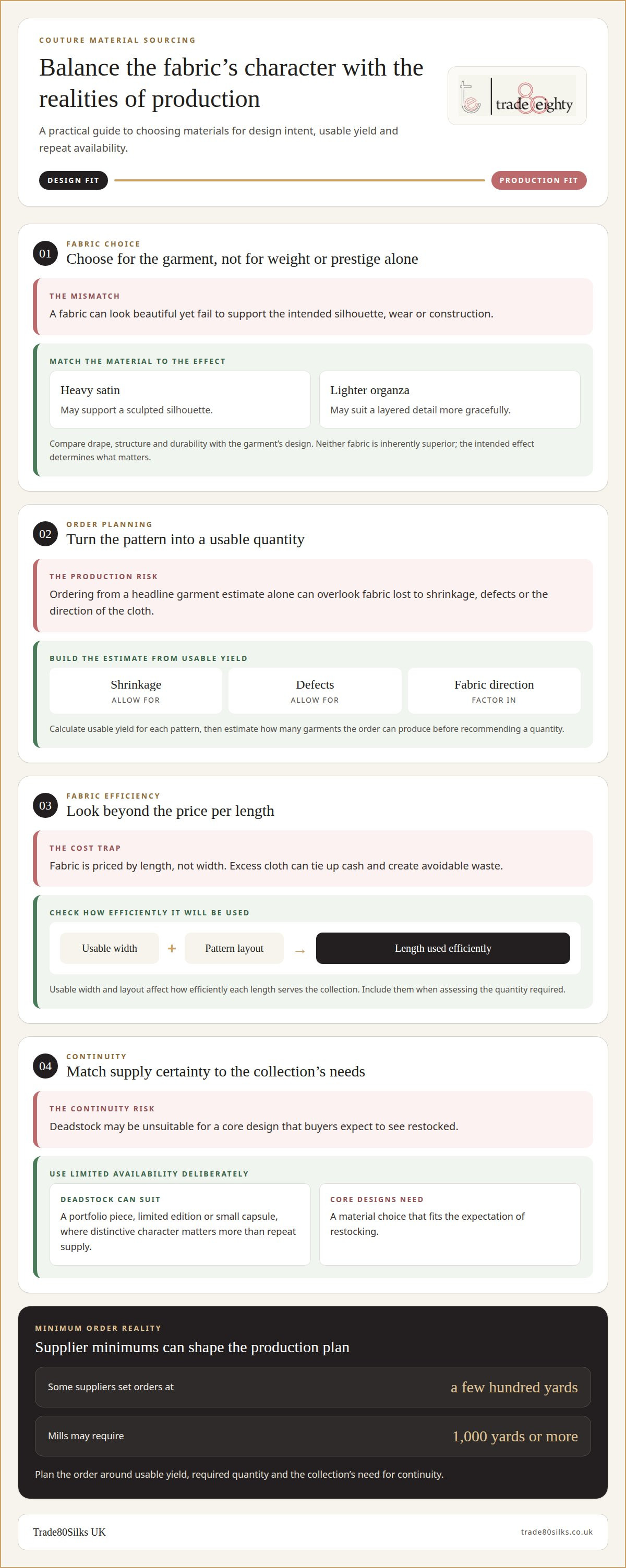
How a professional weighs material sourcing trade-offs for couture
In material sourcing for couture designers, a fabric earns its place through suitability, not weight or prestige alone. Compare its drape, structure and durability with the garment’s design. Heavy satin may support a sculpted silhouette, while lighter organza may suit a layered detail more gracefully. The right choice achieves the intended effect without compromising wear or construction.
For material sourcing for couture designers, order planning turns that judgement into production quantities. The partner calculates usable yield for each pattern, allowing for shrinkage, defects and fabric direction. They then estimate how many garments the order can produce before recommending a quantity. Fabric is priced by length, not width, so usable width and layout affect how efficiently each length serves the collection. Excess cloth can tie up cash and create avoidable waste.
Availability changes the balance. Deadstock can suit a portfolio piece, limited edition or small capsule, where its distinctive character matters more than repeat supply. It may be unsuitable for a core design that buyers expect to see restocked. For emerging designers, the partner weighs that continuity risk against the creative value of a rare textile.
Environmental considerations require more than a single label. Compare performance, traceability, durability and repair potential alongside environmental impact and visibility into social risks. Complex fibre blends can be harder to separate for recycling; bonded layers or difficult-to-remove trims may complicate repair. A more circular design considers repeated wear, repair, reuse and possible recycling at the garment’s end of life.
Global sourcing adds another practical dimension: provenance and production stages shape a material’s traceability, whilst lead times and availability affect delivery planning. A sourcing partner sets consistent comparison criteria across options, recording price, minimum quantity, durability and delivery timing alongside performance. The final recommendation should make the trade-off explicit: which qualities the design prioritises, what compromises follow, and whether the fabric supports the collection’s intended lifespan.
Where can a sourcing partner find specialist fabrics and trims for UK couture designers?
A sourcing partner can draw on stock-supported materials, specialist mills and fabric agents to match cloth with a couture brief. For smaller collections, these routes may offer alternatives to commissioning a full production run. A limited-edition approach can also suit a distinctive textile when repeat availability matters less than the design’s individuality.
The London Textile Fair is a yearly trade fair where fabric manufacturers and their agents exhibit to UK fashion buyers and designers. Use it to assess a fabric range against its intended use, then coordinate sampling before production. The fair is one route into the market; direct mill relationships may suit projects requiring a particular weave, finish or custom development.
For specialist cloth, map each stage of origin and manufacture. Establish where fibres are produced and where the fabric is spun, woven or knitted, dyed and finished. This traceability gives designers a clearer picture of the supply route behind a material, whether they are considering natural fibres, printed cloth or a specialised construction.
Consider fabric and trims together. Coordinate the cloth with labels and other trims, sampling, approvals and the production schedule. For example, delicate embroidered fabric may call for trims and handling suited to its surface, while structured fabric may need a different balance. Keeping these decisions connected helps preserve the intended finish.
Small collections may also benefit from shared production runs, where a suitable material is sourced alongside other requirements, or from stock-supported cloth that avoids committing to a larger exclusive run. Weigh these routes against the design’s quantity, repeat needs and delivery schedule. This can be particularly useful for limited capsules, where material character and practical supply must work together.
For a project that calls for a distinctive textile developed around its design, explore bespoke fabric sourcing.
Trade80Silks UK
Trade80Silks UK is a natural next step when a couture design calls for considered silk and natural fabric sourcing. Its curated materials, sourced from premier silk mills, give designers options for weighing colour, texture and drape against a garment’s intended finish. The selection includes Crinkle Silk Satin ( #167 ), Printed Silk Organza ( PS PEG 5 ), Printed Tulle ( PS PET 3x ) and Printed Silk Devore' ( PS CP8 ).
For a project requiring a more individual material direction, bespoke fabric commissions can bring custom-woven fabrics, jacquards, embroideries and digital prints into the sourcing conversation. This can be useful when a standard textile does not express the design brief or the collection’s distinctive character. Share the intended application and material priorities to start a focused discussion.
Contact Trade80Silks UK to discuss fabric sourcing for your couture project.
Shape the next material decision with intention
The next step is to turn a creative direction into a textile brief that serves both the garment and the collection. Consider the movement, surface and finish you want the cloth to bring, then use those qualities to guide the sourcing conversation. Thoughtful material sourcing for couture designers begins with a clear connection between artistic intent and practical use.
Trade80Silks UK’s selection includes Crinkle Silk Satin ( #167 ), Printed Silk Organza ( PS PEG 5 ) and Printed Tulle ( PS PET 3x ), each offering a distinct starting point for design development. Whether your direction calls for a fluid surface, a sheer layer or a more individual fabric concept, a focused conversation can help bring the material brief into view.
Take the next step and contact Trade80Silks UK to discuss the fabric direction for your couture project. Let the material decision begin with the character your design deserves.
Frequently Asked Questions
How much do couture fabrics such as silk, lace, embroidery and cashmere cost in the UK?
UK couture fabric costs vary with fibre, construction, finish, embellishment, order quantity and availability. Plain silk and embroidered textiles involve different production processes, so comparing only the price per metre can obscure a material’s true value. For a useful budget, assess usable width and yield alongside care needs, expected longevity and the fabric’s role in the finished garment.
How can a sourcing partner verify fabric quality, fibre content, provenance and ethical credentials?
Check that the physical sample matches its technical description and supporting records. If, for example, the sample’s handle or appearance conflicts with its stated fibre content, resolve the discrepancy before approval. Organise provenance records alongside the approved swatch, so the design team can trace the selected material during later production discussions and distinguish it from similar fabrics.
How can a new couture designer build reliable supplier relationships with professional sourcing support?
Professional support helps a new designer establish a clear approval process before committing to production. For an emerging collection, the sourcing partner can help separate essential fabric requirements from elements open to adjustment, then coordinate sample review and communicate approved changes. Keeping decisions in one documented record gives both the design team and supplier a shared reference as the collection develops.


