

The silk with the most alluring name isn’t always the right choice for your pattern. When comparing silk fabric types for dressmaking, the weave and finish can tell you more about a cloth’s drape, opacity and handling than the label alone.
Choosing can feel uncertain: satin, organza, raw silk and sand-washed silk suggest very different qualities, yet online descriptions don’t always show how a fabric will move or behave once cut and sewn. Match the cloth to the garment rather than choosing simply by a familiar name.
This guide explains how common silk fabrics, including crinkle silk satin, printed silk organza and silk devoré, differ in surface and likely use. You’ll learn how to weigh softness, structure and movement against your design and sewing experience, and what to check before ordering, from fibre content and stated weight to opacity, finish and care guidance. With those details in view, choosing silk for your next project becomes a considered decision rather than a guess.
Key Takeaways
- Learn how silk fabric types for dressmaking differ, and why familiar names can describe a fibre, construction or finish.
- Compare fabrics such as crepe de chine, chiffon and dupion to identify options suited to your pattern and preferred finish.
- Use garment requirements, including fluidity, structure and opacity, to guide your choice rather than relying on a fabric name alone.
- Before ordering or cutting, check fibre content, stated weight, width and care guidance, then assess the cloth’s feel and behaviour.
- Know when a fabric specialist can help clarify unfamiliar descriptions or assess a fabric’s suitability for your project.
Silk fabric types for dressmaking: what do the names actually mean?
Silk is a natural fibre. Names such as satin, chiffon and organza describe the cloth’s construction or character, while terms such as sand-washed refer to a finish. This distinction matters because a fabric name alone doesn’t confirm how a cloth will drape, feel or perform in a garment. For a broad introduction to the fibre and its production, see Silk.
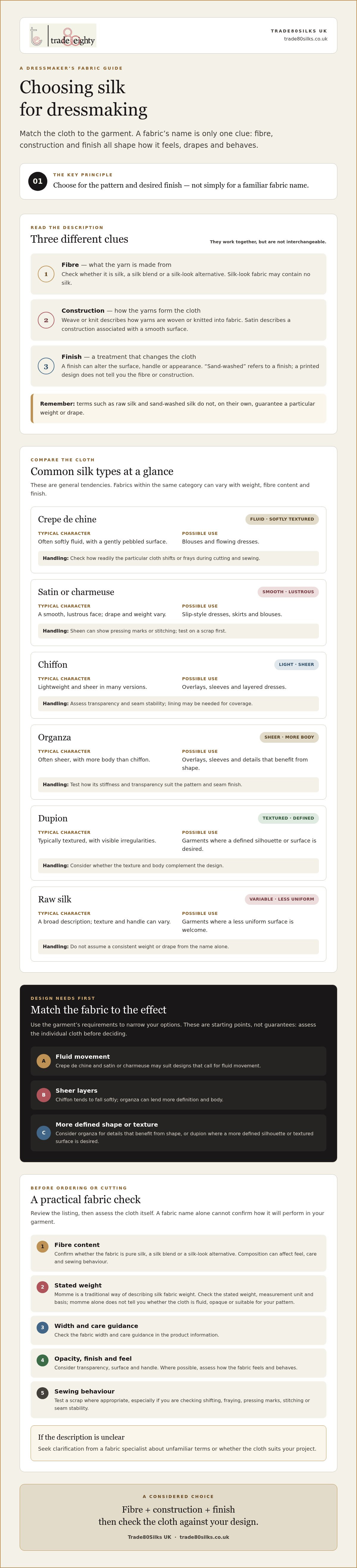
In brief: fibre tells you what the yarn is made from; weave or knit describes how the yarns form the cloth; finish refers to treatments that alter its surface, handle or appearance. These details work together, but they aren’t interchangeable.
- Fibre: the material forming the yarn, such as silk or a combination of silk and another fibre.
- Construction: the way yarns are woven or knitted into fabric.
- Finish: a treatment or process that changes the cloth’s surface or handle.
This is why silk fabric types for dressmaking can sound similar yet behave quite differently. Satin, for example, describes a construction associated with a smooth surface, while printed silk organza combines a fabric category with a printed surface. Raw silk and sand-washed silk also refer to qualities or treatments, not a guaranteed weight or drape.
Listings may describe a fabric as pure silk, a silk blend or silk-look. Check the fibre composition in the product information rather than relying on the name or appearance. Silk-look alternatives may contain no silk, while blends combine silk with other fibres. Composition can affect feel, care and sewing behaviour, so confirm it before choosing fabric for a pattern.
Fibre, weave and finish: three different kinds of fabric information
Think of these as separate clues. Fibre content identifies what the yarn is made from; weave or knit describes how those yarns interlace or form the cloth; finish changes qualities such as lustre, softness or surface texture. A printed design, for instance, doesn’t tell you the fibre content or construction. Read each description as a whole rather than treating one term as a complete specification.
What does silk weight or momme tell a dressmaker?
Momme is a traditional way of describing the weight of silk fabric. It can help you compare listings, but it won’t tell you by itself whether a cloth is fluid, opaque or suitable for your pattern. Construction and finish also influence how fabric hangs and handles. Check the stated weight, measurement unit and basis for each fabric, and seek clarification if the listing doesn’t make these clear.
Common silk fabric types for dressmaking and how they behave
Names are a useful starting point, but fabrics within the same category can feel and perform differently according to weight, fibre content and finish. Use this comparison as a guide to likely behaviour, then check the details of the individual cloth. For a broader overview of the properties of silk, including its texture and strength, see MasterClass.
| Type | Typical character | Possible garment use | Handling consideration |
|---|---|---|---|
| Crepe de chine | Often softly fluid with a gently pebbled surface | Blouses and flowing dresses | Check how readily the particular cloth shifts or frays during cutting and sewing. |
| Satin or charmeuse | A smooth, lustrous face; drape and weight vary | Slip-style dresses, skirts and blouses | The sheen can show pressing marks or stitching, so test on a scrap first. |
| Chiffon | Lightweight and sheer in many versions | Overlays, sleeves and layered dresses | Assess transparency and seam stability; lining may be needed for coverage. |
| Organza | Often sheer with more body than chiffon | Overlays, sleeves and details that benefit from shape | Test how its stiffness and transparency suit the pattern and seam finish. |
| Dupion | Typically textured, with visible irregularities | Garments where a more defined silhouette or surface is desired | Consider whether the texture and body complement the design. |
| Raw silk | A broad description; texture and handle can vary | Garments where a less uniform surface is welcome | Don’t assume a consistent weight or drape from the name alone. |
Fluid and lightweight silks for movement and layering
Crepe de chine and satin or charmeuse may suit designs that call for fluid movement, while chiffon and organza are often chosen for sheer layers. The difference is in the effect: chiffon tends to fall softly, whereas organza can lend more definition. These are general tendencies, not guarantees. Check the exact cloth for transparency, seam stability and whether the finished garment needs a lining. Printed silk organza, for example, brings a pattern to an organza base, but its particular opacity and handle still need assessing.
More textured or structured silks for shape and surface
Dupion and raw silk can offer a more pronounced surface or body than a fluid dress silk, though the result depends on the individual fabric. Sand-washed silk describes a finish, not a separate fibre, so check its handle against the garment you have in mind. Printed silk devoré has a distinct surface treatment; inspect the fabric description and design to understand its effect on the cloth. For a closer look, explore a silk organza fabric guide. If terminology or suitability remains unclear, browse silk fabric options and seek guidance from a fabric specialist.
Which silk fabric suits your dress pattern and desired finish?
Begin with the shape you want the garment to hold, then consider how much movement, coverage and surface interest the design calls for. Silk fabric types for dressmaking aren’t interchangeable: a cloth that floats beautifully in a loose blouse may not support a defined bodice without additional structure. The Silk: Fibre, Fabric and Fashion reference from the V&A offers further context on silk’s materials and techniques, but your pattern and the specific fabric remain the practical guides.
| Garment requirement | Fabric qualities to consider | What to assess |
|---|---|---|
| Soft movement | Fluid drape, light or moderate body | How the cloth falls in folds and whether it suits the pattern’s intended volume. |
| Coverage | Opacity, density and colour | Whether the fabric needs lining, particularly in bright light or over seams. |
| Defined silhouette | More body, a stable surface or added structure | Whether the fabric supports the shape and allows clean seams and closures. |
| Distinctive finish | Lustre, texture or printed detail | How the surface looks across larger pattern pieces and at seam lines. |
| Movement on the bias | Construction and pattern placement | How the fabric stretches or shifts when cut on the bias; don’t assume all silks behave alike. |
Choosing silk for blouses, skirts and flowing dresses
For a blouse or flowing skirt designed to move, look for fabrics with a softer drape, then check that the particular cloth hangs as the pattern intends. Lightweight or sheer fabric may call for lining, a slip or carefully planned layering, depending on the desired coverage. Review the pattern’s fabric guidance and test a sample for transparency and seam behaviour. Stretch on the bias depends on both construction and cut, so follow the pattern’s grainline rather than relying on the fabric name.
Choosing silk for structured or occasion garments
A defined bodice, gathered detail or sculpted skirt may call for more body or support than a fluid design. Consider how the cloth handles seams and closures, and whether the pattern specifies interfacing or lining. A textured silk can lend a tactile character, while lustrous satin brings a more reflective surface that may highlight seam placement. For more on that finish, consult the crinkle silk satin guide.
A swatch is more reliable than a label: handle it, observe it in different light and compare it with the pattern instructions before cutting. If you’re weighing up options, explore silk fabrics for dressmaking and ask a fabric specialist about suitability for your project.
How to assess silk fabric before cutting and sewing
A careful check before you order or cut can prevent an unsuitable cloth from compromising an otherwise well-chosen pattern. Silk fabric types for dressmaking vary in fibre content, weight, finish and handling, so assess the individual fabric rather than relying on its category name. Use this checklist to make a considered choice.
What to check on a fabric listing or sample
- 1. Confirm fibre content. Check whether the fabric is pure silk, a silk blend or a silk-look alternative. The name and appearance alone don’t confirm its composition.
- 2. Read the specifications. Note the stated weight and unit, fabric width, description and care guidance. If any detail is unclear, ask the supplier to confirm it before ordering.
- 3. Compare it with your pattern. Check the pattern’s fabric recommendations, lining requirements and layout before working out how much cloth you need. Make sure the width suits the pattern pieces.
- 4. Assess a sample, if available. Let it fall over your hand to judge drape, hold it to the light to assess opacity, and feel its surface. Gently handle it to understand how it shifts or recovers, without assuming the result will be the same across all silks.
- 5. Test sewing and pressing. Use a suitable offcut to check seam appearance, needle and stitch settings, and how the fabric responds to your pressing approach.
A sample won’t reproduce every part of a finished garment, but it can reveal practical details a product photograph cannot, such as whether seams show clearly or the surface marks during pressing.
Preparing silk for a sewing project
Follow the care instructions for the specific fabric before washing, steaming or otherwise pre-treating it. Don’t assume one silk can be treated like another: fibre blends and finishes may call for different care. Before sewing, test your needle, stitch length and pressing method on an offcut, using an approach suited to the cloth rather than applying the same settings to every fabric.
Handle delicate cloth with care as you lay it out and cut, and consider whether it needs stabilising for the pattern or construction. The appropriate method depends on the fabric and garment, so check the pattern guidance and test first. If you’re still weighing up listing details or sample behaviour, explore silk fabrics and ask a specialist for guidance on their suitability for your project.
Where to explore silk fabric types for your next dressmaking project
Choose in a clear sequence: start with the garment and pattern requirements, decide how you want the fabric to move and feel, compare the cloth’s specifications, then assess a sample where possible. This makes the names of silk fabric types for dressmaking a useful starting point, rather than the sole basis for your decision.
A final checklist for matching silk to a pattern
- 1. Read the pattern guidance. Note its recommendations for fabric weight, drape and construction, along with any lining or interfacing requirements.
- 2. Compare the cloth’s details. Check fibre content, finish, stated weight and width against the needs of the design. If you have a sample, assess its drape, opacity, surface and handling.
- 3. Plan the layout. Allow for lining, print placement and any directional or textured surface that may affect how pattern pieces can be arranged. Check the required quantity against the fabric width and pattern instructions.
- 4. Resolve uncertainties before cutting. Confirm unclear specifications or care guidance with the supplier, and test sewing and pressing on an offcut if available.
Each fabric has its own characteristics, so verify product-specific details rather than assuming that cloths with similar names will behave alike.
When to ask a fabric specialist for guidance
A specialist can help clarify whether a description refers to construction, finish or fibre blend, and discuss how the cloth may suit your intended garment. This is particularly useful when a listing leaves questions about composition, drape or handling unanswered. Bring the pattern requirements and any sample observations into the conversation to make the discussion more focused.
Trade80Silks UK offers a curated selection of silk and natural fabrics by the metre and for larger orders. Where a project calls for a specific design direction, bespoke fabric development may also be relevant for custom jacquard, embroidery or digital printing. If you’re exploring a printed design, the digital print on silk process guide is a useful next topic to investigate; confirm the suitability of any particular fabric for your intended process.
With more than 35 years of industry experience, Trade80Silks can help you consider fabric options in relation to your project. Explore its curated silk and natural fabrics, and ask a fabric specialist about construction, finish or suitability before settling on your cloth.
Choose silk with confidence for your next project
The best silk for a dressmaking pattern is the cloth whose behaviour suits its shape, movement and finish, not simply the fabric with the most familiar name. Weave, fibre content and finish each offer different clues, so check the specific fabric details and assess a sample before cutting whenever possible.
Use your pattern’s guidance to compare drape, body and opacity, then factor in lining, surface texture and handling. Understanding how silk fabric types for dressmaking differ will help you make a more considered choice, whether you’re planning a fluid blouse or a garment with a more defined silhouette.
Trade80Silks UK brings over 35 years of industry experience to a curated selection of silk and natural fabrics, with bespoke fabric development available for projects requiring a particular direction. Explore Trade80Silks’ curated silk fabrics to find a cloth that supports your design.
Frequently Asked Questions
What is the best type of silk fabric for dressmaking?
There’s no single best silk for every dressmaking project; the right choice depends on your pattern and intended finish. A fluid fabric may suit a flowing dress, while organza can add a sheer layer with more body. Compare the cloth’s drape, opacity, surface and construction with the garment requirements, and assess a sample if possible. Check fibre content and care guidance too, since similarly named fabrics can behave differently.
Which silk is easiest to sew for beginners?
No silk type is automatically easy for every beginner, as weight, finish and construction all affect handling. A stable, opaque fabric may feel more manageable than a very sheer or slippery one, but check the particular cloth before buying. Try a sample or offcut first, and practise your needle, stitch and pressing settings. Choose a pattern with clear fabric guidance and avoid starting with a design that depends on difficult bias handling or delicate seams.
What is the difference between silk satin and silk crepe?
Silk satin is associated with a smooth, lustrous face, while silk crepe generally has a more textured, less reflective surface. Their drape and weight can vary, so the names alone don’t predict how either fabric will behave in a finished garment. Satin may suit a design seeking sheen; crepe can offer a more subdued surface. Check the individual fabric’s description and sample, especially for opacity, movement and pressing response.
Is silk organza suitable for making a dress?
Yes, silk organza can be used in dressmaking, particularly where a sheer layer or added shape is desired. Depending on the cloth and design, it may work as an overlay, sleeve or component of a layered dress. Its transparency and body can vary, so assess a sample alongside the pattern. Consider whether the garment needs lining, and check how the chosen organza handles seams and finishes before cutting.
Can you use chiffon silk for a dress without lining?
Yes, if a sheer finish is intentional, chiffon can be used without a lining, for example as an overlay or a deliberately transparent layer. For a dress requiring coverage, the particular chiffon’s opacity may mean you need a lining, slip or carefully planned layers. Check the fabric in the light and consider how seams will show through. The pattern design, fabric colour and individual cloth all affect the final result.
What does momme mean when buying silk fabric?
Momme is a traditional unit used to describe the weight of silk fabric. It can help you compare listings, but it doesn’t tell you by itself how opaque, fluid or suitable a fabric will be for a particular pattern. Construction and finish also shape its behaviour. Check the stated weight, unit and measurement details for the specific cloth, then use a sample and the pattern guidance to judge whether it meets your needs.
How do I choose the right silk fabric for my sewing pattern?
Start with the pattern’s guidance on weight, drape and construction, then compare those requirements with the fabric’s fibre content, finish and stated specifications. Consider the desired movement, opacity and surface, as well as whether the design needs lining or additional structure. If possible, handle a sample to assess drape and seam behaviour. Confirm care instructions before pre-treating, and test sewing and pressing on an offcut before cutting your garment pieces.


