

“Mill-sourced” can tell you who supplied a cloth, but not where its silk fibre was grown, spun or woven. For anyone searching for silk mill sourced fabric uk, that distinction matters: the phrase suggests a connection to a mill, yet may leave the journey from fibre to finished fabric unclear. When choosing cloth for a considered project, it helps to look beyond the description.
This guide explains what mill-sourced silk can mean, how it moves through production and which details help you judge whether a fabric suits your intended use. You’ll learn to distinguish the origins of fibre, yarn and cloth, and to consider how weave, finish and printing affect a material’s character. We’ll also cover what makes a sourcing claim useful, from clear fibre-content information to details about construction. Trade80Silks UK supplies designers and makers with fabrics sourced from premier silk mills, offering a curated starting point alongside practical ways to assess cloth against your design brief.
Key Takeaways
- “Mill-sourced” describes a sourcing relationship, not a recognised silk grade or a guarantee of performance.
- Distinguish where the fibre, yarn, weaving, finishing and distribution each take place.
- Assess silk mill sourced fabric uk by weighing sourcing details against the cloth’s construction and intended use.
- Match handle, opacity, drape, lustre, weight and surface finish to the demands of your garment or creative project.
- A curated mill-sourced selection and bespoke textile development can help you meet a considered design brief.
What Does Silk Mill-Sourced Fabric in the UK Actually Mean?
“Mill-sourced” describes a supply relationship: the fabric has been obtained through a textile mill or a merchant’s relationship with one. It is not a recognised quality grade, and it doesn’t, by itself, tell you where the silk fibre was produced or where the finished cloth was made. When assessing silk mill sourced fabric uk, separate these details to understand what the provenance claim actually tells you.
In brief: mill sourcing identifies a route through the supply chain; a country-of-origin claim identifies where a specified production stage took place. Fibre production, yarn processing, fabric construction, finishing and distribution may each happen in different locations and involve different businesses. Fabric sourced through a mill is not necessarily British at every stage, or even woven in the UK.
What does a silk mill do?
A textile mill may turn yarn into cloth by weaving or, depending on its equipment and specialism, knitting. Its role may focus on fabric construction, with other stages handled elsewhere. Some mills manage several production processes; others work alongside merchants, converters, printers or finishers.
A merchant sources and supplies fabric. A converter may arrange for material to be processed or finished, while a printer applies a design to cloth. A garment manufacturer cuts and assembles fabric into clothing. These roles can overlap or be organised differently across supply chains, so the word “mill” alone does not describe every operation behind a particular silk.
Does mill-sourced silk mean British-made silk?
No. The location of a UK supplier is separate from the origin of the fibre and the places where yarn is spun, cloth is woven or fabric is finished. UK silk production has its own history, including historic weaving centres such as Macclesfield and Congleton. The history of the UK silk industry offers context for that tradition, but heritage alone doesn’t establish the origin of a specific fabric.
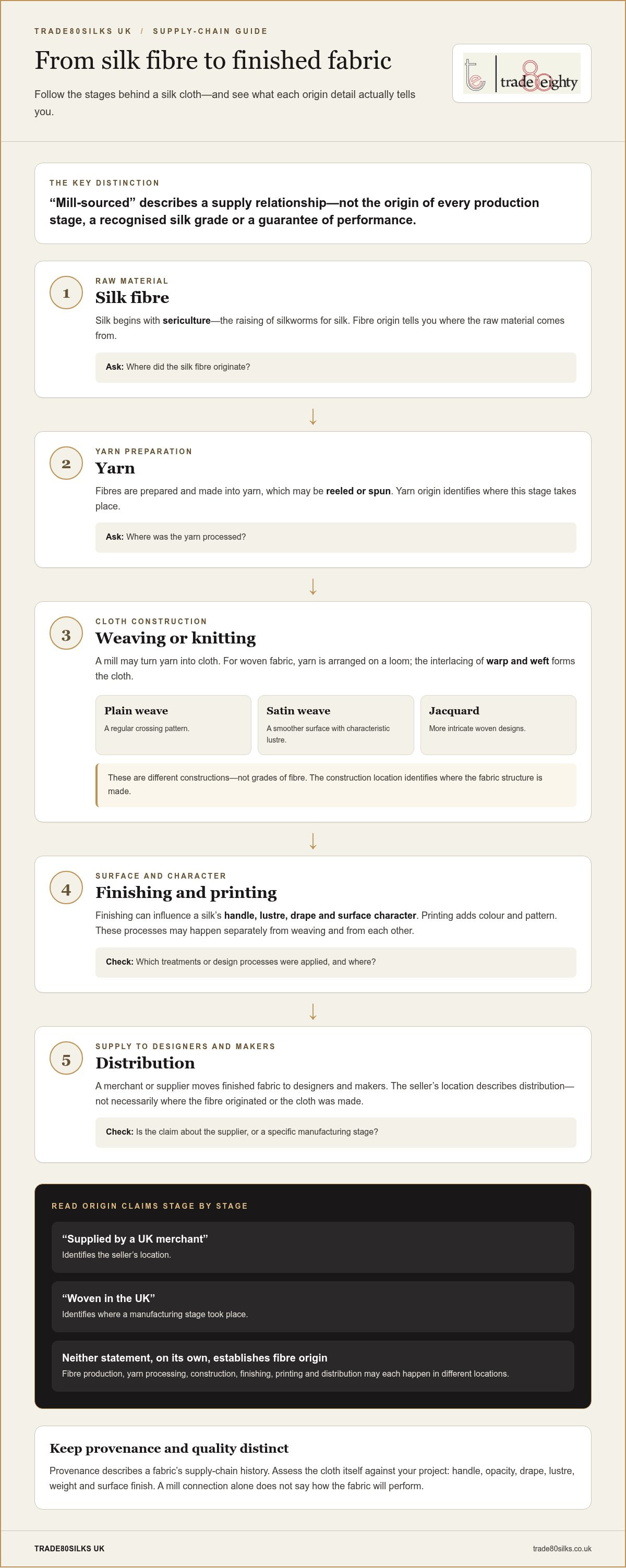
Read provenance wording stage by stage. “Supplied by a UK merchant” identifies the seller’s location; “woven in the UK” identifies a manufacturing stage. Neither statement automatically establishes where the silk fibre originated. Precise descriptions are more useful than broad associations with British craftsmanship, particularly when your project depends on a specific origin or process.
From Silk Fibre to Finished Fabric: How Mill Sourcing Works
A finished silk cloth passes through several stages, and the businesses and locations involved can change along the way. A mill may weave yarn into fabric, for example, while another supplier handles printing or finishing. Following the sequence helps clarify what a sourcing description tells you and which production stages an origin claim refers to.
- Silk fibre: produced through sericulture, the raising of silkworms for silk. Fibre origin refers to where the raw material comes from.
- Yarn: fibres are prepared and made into yarn, which may be reeled or spun. Yarn origin identifies where this stage takes place.
- Fabric construction: yarn is woven or knitted into cloth. The construction location identifies where the fabric structure is made.
- Finishing and printing: treatments or designs are applied to alter or enrich the cloth. These stages may happen separately from weaving, so their locations can differ.
- Distribution: a merchant or supplier moves finished fabric to designers and makers. The seller’s location describes distribution, not necessarily manufacture.
How does silk become woven fabric?
Silk fibre begins with sericulture, but a fabric supplier or mill may enter the chain much later. Prepared yarn is arranged on a loom, where the interlacing of warp and weft forms the cloth. Plain weave has a regular crossing pattern; satin weave creates a smoother surface with characteristic lustre; jacquard weaving forms more intricate woven designs. These are different constructions, not grades of fibre.
Where do finishing and printing fit into the process?
After construction, finishing can influence a silk’s handle, lustre, drape and surface character. Printing adds colour and pattern to cloth and may take place at a separate site. For a closer look at this stage, explore our guide to digital printing on silk.
For a project brief, record each origin separately rather than treating “made in” as a single answer: fibre origin, yarn processing, weaving, finishing, printing and distribution. Documentation may give more detail about some stages than others, so a clear description should specify which stage an origin statement covers. This distinction also gives context to discussions of UK textile onshoring, which concern manufacturing activity rather than the origin of every fibre in a finished cloth.
To assess silk mill sourced fabric uk, connect its documented production stages with the qualities your project needs. Trade80Silks UK’s curated fabrics are sourced from premier silk mills, and its silk and natural fabric selection gives designers a starting point for exploring cloth by the metre or in bulk.
How to Assess Silk Mill-Sourcing Claims Without Confusing Provenance with Quality
A sourcing description is most useful when it identifies which part of the cloth’s journey it refers to. The word “mill” may suggest expertise and tradition, but neither heritage nor a supplier relationship tells you on its own how a fabric will handle, drape or perform in a finished design.
Provenance describes a fabric’s supply-chain history; quality requires material-specific assessment. Keep these related but distinct ideas in view when reading product descriptions:
| Detail | What it tells you |
|---|---|
| Fibre origin | Where the raw silk was produced. |
| Yarn source | Where silk fibres were reeled or spun into yarn. |
| Weaving location | Where the yarn was constructed into cloth. |
| Finishing location | Where treatments or surface processes were applied. |
| Seller location | Where the fabric is supplied from, which may differ from its production locations. |
What evidence makes a sourcing description useful?
Look for specific information: fibre content, construction such as plain, satin or jacquard weave, and the production stages or locations being described. A named mill or a clear account of the sourcing relationship gives more context than general references to heritage. Certificates, audit documents and origin records aren’t universal requirements; useful evidence depends on the claim and the level of detail your project needs.
Does mill sourcing guarantee better silk?
No. A mill relationship or evocative origin story doesn’t guarantee that a fabric will suit a particular use or meet your expectations for performance. Consider construction, weight, finish and handling requirements alongside the sourcing information. A fluid satin, for instance, may suit a different design brief from a crisp, sheer organza. For a closer comparison of cloth choices, see our guide to silk fabric types for dressmaking.
Heritage can still enrich a fabric’s story. The Victoria and Albert Museum’s national collection of textiles illustrates the breadth of textile techniques and woven silk traditions, offering perspective on craftsmanship. Historical significance, a mill’s reputation and a fabric’s suitability remain separate considerations.
When choosing silk mill sourced fabric uk, assess the cloth against its intended garment or creative application. Examine handle, opacity, drape, lustre, weight and surface finish, then weigh these qualities against the provenance details. A precise sourcing account helps explain the fabric’s journey; examining the material helps you decide whether it suits your project.
A Designer’s Practical Framework for Choosing Mill-Sourced Silk Fabric
Start with the piece you’re making, not the provenance language. Silk for a flowing garment, a bridal detail, a costume, an editorial sample or an interior application may need quite different qualities. Turn the design brief into practical requirements, then compare the cloth’s handle, opacity, drape, lustre, weight and surface finish.
Which fabric details matter most for a design brief?
Construction should support the intended silhouette and movement. A fluid weave can lend softness and swing, while a firmer cloth may help a design hold its shape. For layered details, consider opacity and how sheer fabric behaves over another material. Silk organza, for example, can contribute a crisp, translucent layer. Explore our silk organza fabric guide for more specific considerations.
Before specifying yardage, consider the whole design: fabric width, colour, print placement and repeat, and the consistency required in the finished work. A prominent motif may need careful placement across pattern pieces, while a plain cloth may put more emphasis on colour and surface. If a representative sample is available, assess it in context, including how it falls, feels and looks under the lighting relevant to the project. Sampling can reveal details that a description alone cannot convey.
How should trade buyers think about repeat orders?
For production planning, record the fabric’s construction, colour reference, finish and print repeat alongside sample approvals. Colour and surface character can vary between batches or production runs, so don’t assume a later order will be identical. State the tolerances and intended use in your specification, especially when the project depends on matching multiple lengths or coordinating components.
For designers comparing silk mill sourced fabric uk, sourcing information provides context, while the design brief determines which material qualities matter most. A curated selection is a useful starting point, but the final choice should reflect the cloth’s behaviour and the demands of the finished project. If the design calls for a custom textile, bespoke development can bring construction, colour and surface treatments closer to the brief.
Explore silk fabrics for your project, with options supplied by the metre and in bulk to designers and manufacturers.
How Trade80Silks UK Connects Designers with Mill-Sourced and Bespoke Fabrics
Trade80Silks UK is an independent fabric merchant with more than 35 years of industry experience, supplying designers and manufacturers across the UK. Its curated selection brings together premium silk and natural fabrics sourced from premier silk mills, available by the metre and in bulk.
Curated sourcing is a useful starting point, not a substitute for assessing cloth against a project brief. Provenance can explain a fabric’s place in the supply chain, while construction, finish and physical qualities help determine how it may serve a particular design. Considering these elements together helps turn a broad inspiration into a more precise fabric choice.
How can a specialist merchant support a fabric project?
A specialist selection lets designers compare surface, handle, drape and appearance across silk and natural fabrics. A design that relies on fluid movement, for example, calls for a different balance of qualities from one that needs a crisp, translucent layer. Consider the intended use alongside weave and finish to narrow the options.
Clear specifications also support productive project planning. Note the fibre content, construction, colour, finish and print requirements that matter to the design, then relate them to how the cloth will be cut, layered or used. Trade80Silks UK supplies fabric for smaller creative requirements and larger manufacturing needs, connecting mill-sourced materials with the practical demands of making.
When might a bespoke fabric commission be relevant?
A standard cloth may provide the right foundation; other projects call for a distinctive combination of structure, pattern or surface treatment. Bespoke development offers a route when existing fabric does not align closely with the brief. Trade80Silks UK’s bespoke textile services include custom weaving, jacquards, embroidery and digital printing, giving designers different methods to consider for a project-specific textile.
These options can be considered in relation to the intended application, from the character of a woven motif to the placement and effect of a printed design. Let the brief guide the choice: desired handle, visual depth, colour, construction and the fabric’s role in the finished work.
Whether you’re evaluating silk mill sourced fabric uk for a production run or developing a distinctive textile, begin with the material and its purpose. Explore Trade80Silks UK fabrics and bespoke services for a considered starting point for your next project.
Choose Silk with Provenance and Purpose
“Mill-sourced” describes a relationship in the supply chain, not a quality grade or proof that every production stage took place in the UK. To assess silk mill sourced fabric uk for your project, distinguish fibre and fabric origins, then consider construction, finish, handle, drape and weight in relation to its intended use. Provenance gives useful context; the cloth itself must still meet the design brief.
Trade80Silks UK brings more than 35 years of fabric-industry experience and was founded in 1980. Its curated selection is sourced from premier silk mills, with fabrics supplied by the metre and in bulk. Where a standard cloth doesn’t meet a distinctive brief, bespoke development can include custom weaving, jacquards, embroidery and digital printing.
Explore Trade80Silks fabrics and bespoke textile services to find a considered starting point for your next project. Compare the sourcing details with the qualities your design needs, then choose cloth that supports your creative vision.
Frequently Asked Questions
What does mill-sourced silk fabric mean?
Mill-sourced silk fabric is cloth obtained through a relationship with a textile mill, either directly or through a fabric merchant. The term describes a sourcing route, not a recognised quality grade. A mill may weave yarn into cloth, while other suppliers handle finishing, printing or distribution. Fibre origin, yarn processing and fabric manufacture can take place in different locations, so the phrase alone doesn’t describe every stage.
Does silk mill-sourced fabric mean the silk is made in the UK?
No. The phrase doesn’t establish that the silk fibre or finished fabric was produced in the UK. A UK-based merchant may source cloth from mills elsewhere, and the fibre, yarn, weaving and finishing may each have separate origins. Read the wording precisely: “supplied by a UK merchant” describes the seller, while “woven in the UK” refers to a specific manufacturing stage.
How can I tell whether silk fabric comes from a mill?
Look for a clear description of the mill relationship and the stage it relates to, such as weaving or fabric production. Fibre content and construction details, including whether the cloth is plain, satin or jacquard woven, add useful context. A named mill or specific sourcing account is more informative than general heritage language. Documentation can vary, and no single record is a universal requirement for every sourcing claim.
Does mill-sourced silk guarantee better fabric quality?
No. Mill sourcing doesn’t guarantee that a silk will suit your project or perform in a particular way. Assess the fabric itself, including its construction, weight, handle, opacity, drape and finish. A smooth, fluid cloth and a crisp, sheer silk may serve very different design purposes. Provenance helps explain a fabric’s supply-chain history; suitability depends on the material and its intended use.
What is the difference between a silk mill and a fabric merchant?
A silk mill is involved in making cloth, often by weaving yarn, although its exact role can vary. A fabric merchant sources and supplies textiles to designers, makers and manufacturers, and may connect customers with mills. Other businesses may handle printing, finishing or garment construction. These roles can overlap within a supply chain, so a seller’s relationship with a mill doesn’t mean the seller made the fabric.
What should designers check when choosing mill-sourced silk?
Start with the end use, then compare the cloth’s weave, handle, opacity, drape, lustre, weight and finish with the design brief. Consider colour, print repeat and consistency needs before planning quantities. If a representative sample is available, assess it in context before committing to a larger project. For silk mill sourced fabric uk, distinguish sourcing details from the fabric qualities that determine whether it suits your design.
Can mill-sourced silk be printed or customised?
Yes. Silk can be printed after the fabric has been constructed, and printing may take place separately from weaving. Custom development can also include changes to the weave or added surface detail. Trade80Silks UK offers bespoke fabric commissions that include custom weaving, jacquards, embroidery and digital printing, giving designers ways to develop a textile around a distinctive project brief.


