

What if the silk that looks most luxurious on the bolt proves difficult to shape into your intended design? Choosing silk fabric for couture involves more than judging colour, lustre or a familiar fabric name. Weave, weight and finish all influence how a cloth falls, holds shape, responds to cutting and behaves at the seams.
Appearance alone can’t show whether a fabric will support a sculpted bodice, flow through a soft skirt or take the finish your design requires. This guide explains the structural qualities behind those differences, so you can assess a silk against the garment you’re making rather than relying on its label. Learn what to observe in its drape, body, grain and surface, and how to handle and sample fabric before committing to a design. Understanding how construction shapes performance makes it easier to choose with purpose.
Key Takeaways
- Judge silk fabric for couture by how its construction supports the garment’s design, not by its name alone.
- Compare the behaviour of drape-led, sheer and more defined cloth to understand the role each could play in a design.
- Match qualities such as body, opacity and surface to the demands of bodices, skirts, sleeves, linings and decorative details.
- Use a consistent sample assessment to observe both sides of the fabric and record how it responds to handling.
- Follow a project-led selection process, with bespoke textile development as an option when a distinctive surface or pattern is central to the design.
What makes silk fabric suitable for couture construction?
For a couture garment, a silk’s suitability depends on how its structure serves the design and the way it will be made. Structural suitability is the degree to which a cloth’s observable behaviour supports the intended silhouette, handling and finish, rather than a judgement based on prestige or price. A lustrous surface may be beautiful, but it cannot tell you on its own whether the cloth will hold a shaped line, fall into soft folds or behave well at a seam.
It helps to distinguish the fibre from the fabric. Silk fibroin is the protein that forms the silk fibre; the yarns made from it are arranged and finished to create a cloth. The history and properties of silk offer useful background on the fibre, but garment behaviour depends on more than its identity. Weave, yarn, weight and surface treatment all contribute to the finished material.
How fibre, weave and finish shape a silk cloth
Weave describes how the threads interlace, influencing a fabric’s surface and movement. Finishing can further affect its handle, lustre and body. Satin, for example, describes a weave associated with a smooth, reflective face, not one guaranteed weight or level of fluidity. The result depends on the cloth’s construction and finish, so treat the name as a starting point for assessment rather than a promise of performance.
What couture makers mean by structure
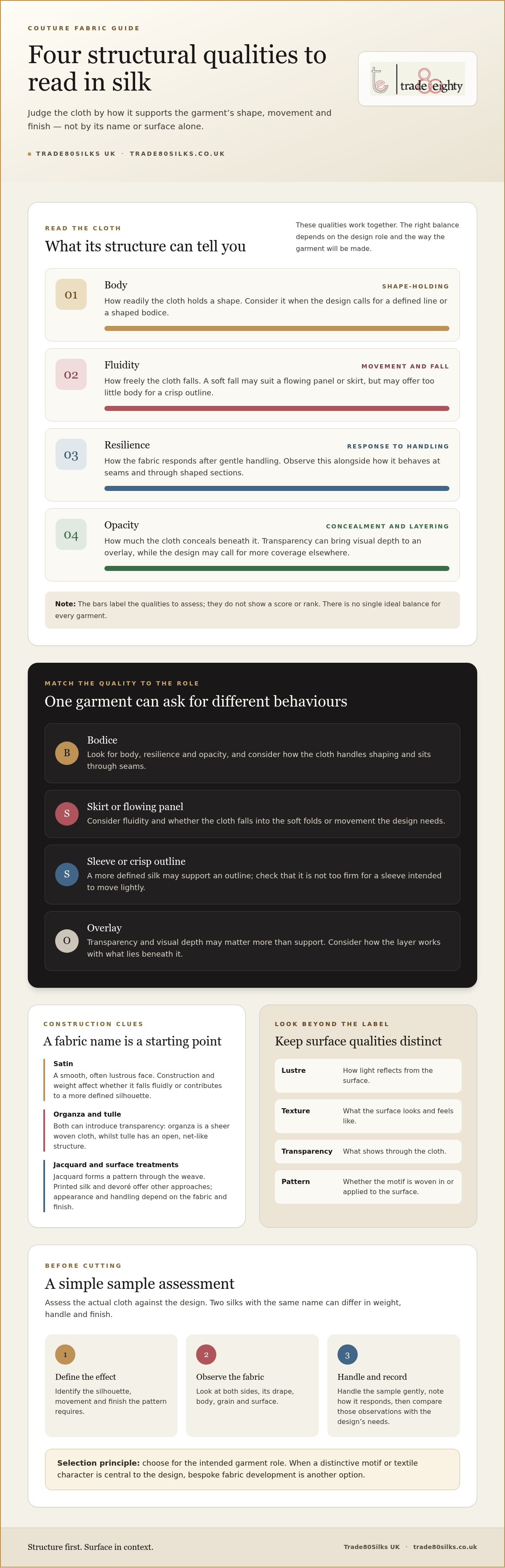
Structure is read through qualities you can observe: body is how readily a cloth holds shape; fluidity is how freely it falls; resilience is how it responds after gentle handling; and opacity is how much it conceals beneath it. These characteristics influence silhouette and layering, as well as how a fabric may sit around support, seams and shaped sections.
The right balance depends on the garment role. A cloth with a soft fall may suit a flowing panel but offer too little body for a crisp outline. A more defined silk may support that outline but feel too firm for a sleeve intended to move lightly. Even within one garment, different areas can call for different behaviours. Assess the fabric against the construction, not against a universal idea of the ideal silk fabric for couture.
Use this as a practical basis for selection: identify the effect the pattern requires, then consider whether the cloth’s structure can help achieve it. Surface beauty matters too, but works best alongside construction qualities that suit the design.
How do silk weave and cloth construction influence garment behaviour?
Weave and finish shape more than a fabric’s appearance: they influence how the cloth catches light, moves, layers and responds to shaping. A fabric name is a useful clue, not a guarantee. Two silks described in the same way may differ in weight, handle and finish, so assess the actual cloth against your design instead of relying on the category alone.
What satin, organza and tulle contribute to a design
Satin is recognised by its smooth, often lustrous face. Depending on its construction and weight, it may fall in fluid folds or contribute to a more defined silhouette; the name itself doesn’t promise either result. Organza is a sheer woven cloth, while tulle has an open, net-like structure. Both can introduce transparency, but their different constructions create distinct visual effects and layering possibilities. For a closer look at organza’s design uses, explore this silk organza fabric guide. For ideas on patterned sheer layers, see the printed tulle fabric guide.
A sheer layer can soften or enrich what lies beneath it, while a more fluid cloth can bring movement to a panel or skirt. Choose according to the intended effect and how the layers, seams and silhouette work together. The V&A’s collection of historical silk textiles also offers a visual sense of the varied ways silk surfaces and structures have been used in textiles.
How surface and weave change the visual result
Consider lustre, texture, transparency and pattern separately. Lustre describes how light reflects from the surface; texture is what the surface looks and feels like; transparency concerns what shows through; and pattern may be woven into the cloth or applied as a print or other surface treatment. Keeping these qualities distinct helps you decide whether the design calls for a quiet sheen, tactile interest, a visible motif or a layered, translucent effect.
With jacquard, the pattern is formed through the weave rather than simply printed on the surface, creating a different relationship between motif and cloth. Printed silk and devoré offer other approaches to pattern and surface, though their appearance and handling depend on the particular fabric and finish. These distinctions matter in silk fabric for couture, where the surface should complement the construction. When a specific motif or textile character is central to the design, bespoke fabric development can bring that intention into the material itself. Explore Trade80Silks UK fabrics and bespoke textile options.
Which structural qualities matter most for different couture design roles?
A fabric’s role in the garment determines which qualities deserve closest attention. A silhouette with soft folds calls for different behaviour from a shaped bodice, while an overlay may need transparency and visual depth more than support. Use the comparisons below to focus your assessment. They are prompts for evaluating a particular cloth, not prescriptions for one universal silk.
| Design role | Desired behaviour | Qualities to assess |
|---|---|---|
| Bodice | Support a defined shape and sit smoothly through seams | Body, resilience, opacity and how the cloth handles shaping |
| Skirt | Fall into the intended line, from fluid movement to controlled volume | Drape, weight, surface movement and whether it holds folds |
| Sleeve | Follow the arm, or hold a deliberately shaped form | Flexibility, body, comfort against a lining and response to seams |
| Lining | Move comfortably beneath the outer cloth without disrupting its silhouette | Handle, opacity, surface friction and compatibility with the outer layer |
| Overlay | Add translucency, depth or a distinct visual layer | Sheerness, body, texture and interaction with the fabric beneath |
| Decorative detail | Bring focus to a feature without overwhelming the garment | Scale of pattern, texture, lustre and how the detail sits against other materials |
Matching fabric behaviour to silhouette and garment area
For a draped panel, observe whether the cloth falls freely and forms the folds the design requires. A defined shape may call for greater body or resilience, particularly where seams and support need to maintain a clear outline. Sheer layers bring different decisions: consider how much of the underlying garment remains visible, how the layers build visual depth and whether the overlay is expected to contribute shape of its own.
These roles can vary within one garment. A design might pair a fluid section with a firmer shaped area, so assess the cloth in relation to its placement, support and neighbouring layers. Use the table as a design aid, then handle samples to see how the fabric actually responds.
When texture, pattern or surface becomes part of the structure
Texture and pattern influence how the eye reads a garment. A pronounced motif can draw attention to a panel, while a smaller or quieter surface may let the silhouette take precedence. Printed silk and silk devoré offer different directions for surface interest, but their appearance and handling depend on the specific cloth. For a closer material reference, explore this crinkle silk satin guide. Assess each option as a whole, considering how its surface, drape and construction work together in the intended role.
How can you assess silk fabric for couture before cutting?
A purposeful sample assessment helps reveal whether a cloth’s appearance is matched by behaviour suited to the garment. Begin with the design and the area the silk will occupy, then observe and record what the sample does. This is especially useful for silk fabric for couture, where a difference in drape, transparency or surface response can influence the finished effect.
A practical sample assessment sequence
- Clarify the design role. Refer to the drawing and identify the garment area, intended silhouette and construction. Note whether the cloth must fall fluidly, hold a defined line, act as a sheer overlay or sit comfortably as a lining.
- Look at both sides. Examine the face and reverse in good light. Note differences in lustre, texture, colour and pattern, and whether the reverse may show at seams, folds or openings.
- Observe the cloth in motion. Hold or arrange the sample as it might sit on the body, then let it move naturally. Watch how folds form and settle, and whether the fabric hangs in the way the silhouette requires.
- Assess opacity and surface. View the sample against the layers or colours it will sit beside. Record how much shows through, how the surface catches light and whether texture or pattern draws attention to a particular area.
- Handle gently and make notes. Notice the hand, body and response to light handling without stretching or pulling the cloth. Record your observations and any design-specific concerns so you can compare alternatives on the same basis.
Check how the fabric responds to making techniques
Before cutting the garment, use a representative sample to explore the techniques planned for the design. Test a seam in the intended direction and construction, and assess how the cloth responds to pressing using an appropriate method for that fabric. If the garment includes embellishment, layering or a lining, try those elements on the sample too. Results can vary with weave, finish and handling, so treat each test as guidance for that particular cloth, not a guarantee of how every piece will behave.
For projects with bridal-specific sourcing considerations, consult this bridal silk supplier checklist. A concise record of appearance, handling and sample construction gives you a sound basis for refining the design before committing the main fabric.
Explore silk fabrics for your couture project as you develop your selection.
How should a couture project move from silk selection to a resolved design?
A considered fabric decision begins with the design’s purpose, then moves through structural assessment, sampling and refinement. Instead of selecting by appearance alone, translate the brief into clear criteria: the silhouette the cloth must support, the movement it should allow, the finish required and the construction it needs to accommodate. These criteria give each decision a practical reference point.
Turn the design brief into fabric criteria
Separate essential requirements from decorative preferences. If a section must hold a defined shape, body and response to shaping may take priority; if it needs to flow, movement may matter more. For a layered design, consider opacity and how the surfaces work together. Then assess candidate silks against these criteria, using samples to explore how each material behaves in its intended role.
Keep a consistent record of sample observations, including the fabric’s face and reverse, handle, drape, surface, opacity and response to planned making techniques. Note which qualities support the design and which may call for a pattern adjustment or a different construction approach. This helps maintain consistency across garment areas and supports a more informed choice of silk fabric for couture.
When bespoke textile development can serve a couture concept
A curated silk may suit the brief when its observed structure, surface and colour align with the design’s priorities. Bespoke development is useful when the concept depends on a particular textile character. Custom jacquard weaving can develop a woven pattern; embroidery can introduce stitched surface detail; and digital printing can bring a designed motif to a silk substrate. Each approach connects the textile more closely to the creative idea, while the resulting cloth still needs to be assessed for the garment’s construction and intended finish.
In practice, define the garment’s purpose, establish the fabric criteria, assess and sample suitable silks, then refine the design in response to what the cloth reveals. This keeps material and making in conversation, allowing the final choice to serve both the visual intention and the construction. Explore Trade80Silks UK fabrics and bespoke work with your design criteria in mind.
Choose silk with confidence for your next couture design
The right silk is the one whose construction serves the garment. Weave, finish and weight all influence how a cloth drapes, holds shape and behaves during making, so assess the fabric against its intended role rather than relying on its name or appearance alone. Sampling, observing both sides and testing planned techniques on a sample can help turn that assessment into a considered design decision.
Begin with the silhouette and essential construction needs, then refine your choice through handling and sampling. Where a distinctive surface or pattern is central to the concept, bespoke textile development, including custom jacquard weaving, embroidery and digital printing onto silk, can form part of the creative process. Trade80Silks UK brings more than 35 years of industry experience to its work with designers and manufacturers.
Explore Trade80Silks UK fabrics and bespoke work as you shape your next project. With a clear brief and a thoughtful approach to silk fabric for couture, you can make confident choices and bring your design intention to life.
Frequently Asked Questions
What makes silk fabric suitable for couture?
Silk fabric is suitable for couture when its construction supports the garment’s silhouette, handling and intended finish. Fibre identity alone doesn’t determine behaviour: weave, yarn, weight and finish all contribute to body, drape, opacity and surface. Assess the actual cloth against its role, such as whether a bodice needs to hold a defined shape or a panel should fall fluidly. A luxurious appearance or familiar fabric name isn’t enough to establish suitability.
Which silk weave is best for couture garments?
No single silk weave is best for every couture garment. The right choice depends on the design and the qualities required: a smooth satin surface may suit a lustrous effect, while a sheer woven cloth or a more textured construction may serve another purpose. Even fabrics described by the same weave can differ in weight and finish. Compare samples for drape, body and surface, then consider how each will work with the garment’s construction.
Can silk organza provide structure in couture?
Silk organza can contribute a defined, sheer layer, but how much structure it provides depends on the particular cloth and its construction. In a couture design, it may add visual depth or help create a layered shape, while remaining distinct from an opaque, supportive fabric. Assess a sample in the garment area where it will be used, paying attention to how it holds folds, layers with other materials and behaves at seams.
How do you test silk fabric before cutting a couture garment?
Start by identifying the fabric’s role and the silhouette it must support, then examine both sides for surface, colour and opacity. Arrange the sample as it may sit in the garment and observe its drape and movement. Handle it gently and record your observations. Before cutting, test a representative sample with the intended seam, pressing method, lining or embellishment. Results depend on the fabric and finish, so use tests as guidance for that specific cloth.
Is silk satin always fluid and drapey?
No. Satin describes a weave associated with a smooth, often lustrous face, not one fixed weight or behaviour. A particular silk satin may fall in fluid folds, while another may have more body and contribute to a defined shape. The result depends on factors such as yarn, construction and finish. Assess the sample directly, observing how it hangs and moves, rather than assuming that the word “satin” guarantees a particular drape.
What is the difference between silk organza and silk tulle for couture?
Silk organza is a sheer woven fabric, while tulle has an open, net-like structure. Both can create transparent layers, but their construction gives them different visual character and ways of interacting with fabrics underneath. The exact behaviour of either depends on the cloth itself. For a couture project, compare samples for transparency, body and how they layer, then consider whether you want a woven sheer effect or the more open appearance of net.
Can silk fabric be customised for a couture design?
Yes. Bespoke textile development can help when a design brief calls for a distinctive pattern or surface. Trade80Silks offers custom jacquard weaving, embroidery and digital printing onto silk substrates. These approaches can bring a motif or decorative idea into the textile, though the resulting cloth should still be assessed for its intended construction and finish. Customisation is most useful when the textile itself is central to the design, rather than simply a choice of colour or fabric category.


